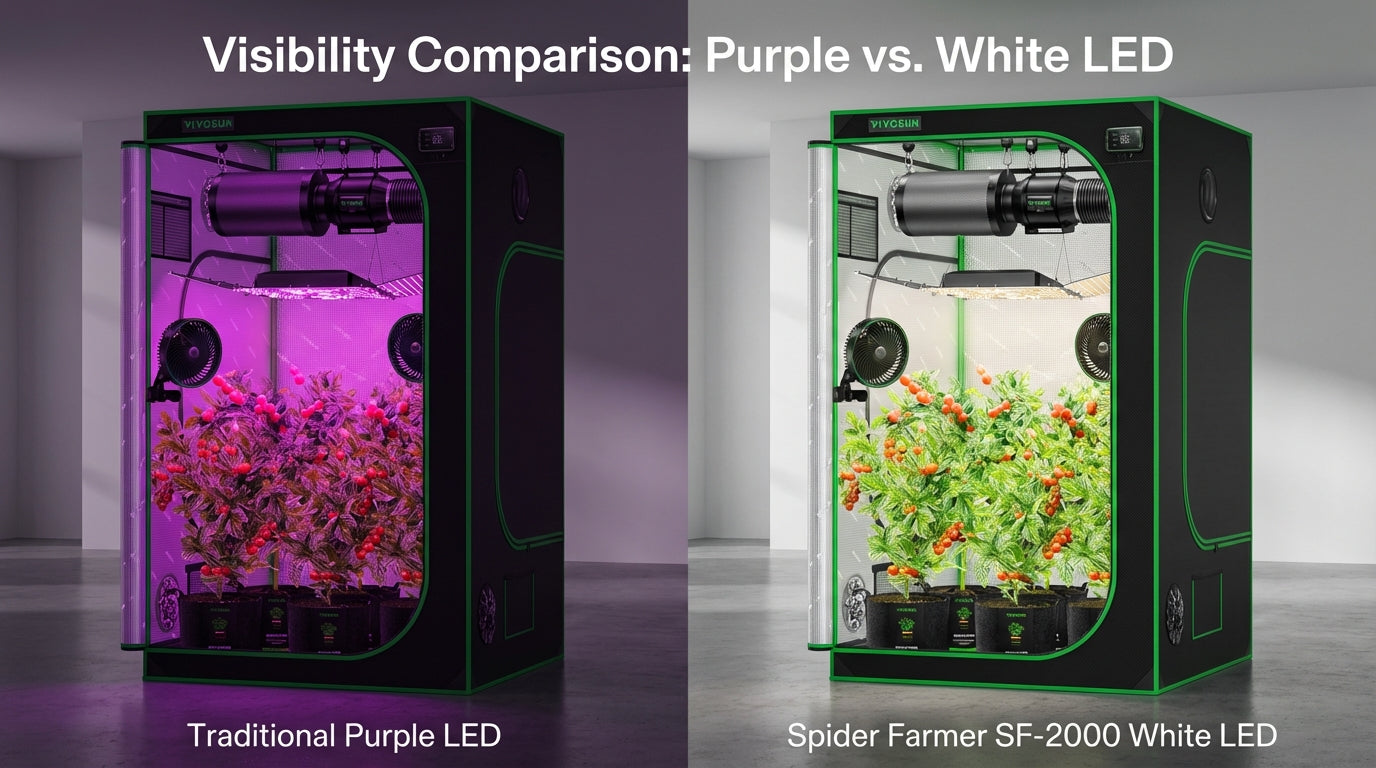
If you walk into a commercial grow facility in 2026, you won’t see purple. You’ll see blinding, sun-like white light. Yet, if you browse online marketplaces for "grow lights," you are still bombarded with cheap fixtures glowing like a 1990s disco.
This discrepancy leaves beginner growers asking a critical question: Is the "blurple" light obsolete, or is it a secret hack for efficiency?
Here is the direct answer to save you time:
Full Spectrum grow lights (White LEDs) are the modern standard because they mimic natural sunlight (Ra > 90), allowing for better canopy penetration and easier plant health diagnosis. "Blurple" lights (Red/Blue only) are older technology that, while technically efficient at driving chlorophyll absorption, fail to support overall plant morphology and make it nearly impossible to spot pests or nutrient deficiencies early. This distinction is the core of the full spectrum vs blurple debate.
In this guide, we break down the physics of light spectra, debunk the "green light is useless" myth using 2026 data, and analyze why the Lumimuse Dimmable 100W LED—with its patented ceramic technology—is the smart upgrade from the purple haze.
1. The Science of Spectrum: Why We Moved Past "Blurple"
To understand why the industry shifted, you have to understand why "blurple" existed in the first place.

The "Blurple" Era (Narrowband LED)
In the early 2010s, white LEDs were inefficient. Scientists knew that plants primarily use Red (660nm) and Blue (450nm) light for photosynthesis.
- Blue light drives vegetative growth and stocky stems.
- Red light drives flowering and fruit production.
Manufacturers stripped away everything else to save power, resulting in lights that emitted only red and blue. To the human eye, this mixes into a deep purple or pink. It worked, but it had major flaws: it ignored the complexity of plant biology.
The Full Spectrum Revolution (Broadband White)
Modern LED technology (like the chips found in the Lumimuse 100W) uses a phosphor coating to turn blue diodes into broad-spectrum white light. This covers the range from 400nm to 780nm.
Why this matters:
- Photosynthesis is not the only goal: Plants use other wavelengths (green, yellow, UV, Far-Red) for signaling. This tells the plant when to stretch, when to flower, and how to build strong cell walls.
-
The CRI Factor (Color Rendering Index): This is the hidden killer of blurple lights.
- Sunlight CRI: 100 (Perfect color accuracy)
- Lumimuse CRI (Ra): ~100 (Near-perfect)
- Blurple CRI: < 20 (Everything looks black or gray)
Pro Tip: If you grow under blurple light, you cannot see spider mites, powdery mildew, or nitrogen deficiency until it is too late. Under a high-CRI white light, you can spot yellowing leaves instantly. For a deeper dive into selecting the right light, check our guide on LED Grow Lights for Indoor Plants.
2. The "Green Light" Paradox: Information Gain
Most beginner articles will tell you that plants reflect green light (which is why they look green). This is a half-truth that modern science has debunked.
Recent agricultural research confirms that while the surface of a leaf absorbs red and blue light, Green light (500-600nm) is the engine of deep-canopy growth.
- Red/Blue are absorbed so quickly they often oversaturate the top leaves.
- Green light passes through the top layer and penetrates deep into the lower canopy.
The result? Plants grown under Full Spectrum white light have healthier lower leaves and less die-off at the bottom of the plant compared to those grown under narrow-band purple light. The Lumimuse 100W includes these essential green wavelengths, ensuring your entire plant photosynthesizes, not just the top 3 inches.
3. Head-to-Head: Lumimuse 100W vs. The Market
Let’s compare the Lumimuse Dimmable 100W against a standard "Blurple" fixture and a generic 100W board. See our comprehensive LED Plant Grow Light Comparison for more market data.
| Feature | Lumimuse Dimmable 100W | Typical "Blurple" (Red/Blue) | Standard Generic White LED |
|---|---|---|---|
| Spectrum | Full Spectrum (380-780nm) | Narrowband (Red/Blue) | White (often limited red) |
| CRI (Visibility) | Ra ≈ 100 (Daylight) | Ra < 20 (Poor visibility) | Ra 80-90 |
| Heat Tech | Patented Ceramic Heat Sink | Loud Fans / Aluminum | Aluminum Board (Hot) |
| Safety | Non-conductive Ceramic (V0 Fire Rated) | often uncertified | Exposed wiring risks |
| Canopy Depth | High (Green light included) | Low (Top leaves only) | Medium |
| Est. Annual Cost | ~$65.70 | Similar | Similar |
The "Chip on Ceramic" Advantage
Most LED boards (PCBs) are made of aluminum. They require a layer of insulation between the LED chip and the metal to prevent short circuits. This insulation layer acts as a thermal barrier, trapping heat.
Lumimuse’s USP: They use Chip on Ceramic technology.
- Direct Soldering: The LED is soldered directly to the non-conductive ceramic heat sink.
- Zero Thermal Resistance: Heat moves instantly away from the diode.
- Result: The light runs cooler without noisy fans, extending the lifespan to 25,000+ hours.
4. Product Spotlight: Lumimuse Dimmable 100W LED

The Lumimuse 100W LED Grow Light is designed to bridge the gap between hobbyist ease and professional spectrum quality.
📺 Related Video: Dimmable 100W LED Grow Light [Action]
Key Specifications:
- Power Draw: 100 Watts (True Draw) – Replaces the output of older ~1000W equivalent incandescent brightness (marketing speak for "very bright," but effectively replaces a 150-200W HPS grow lamp).
- Light Output (PPF): 158 µmol/s.
- Secondary Optics: Unlike bare boards, this unit uses a lens design to distribute light evenly, achieving a PPFD of 577 µmol/s/m² at 12 inches. This is the "sweet spot" for vegetative growth and early flowering for most indoor plants.
- Safety First: The body is made of V0-grade flame-retardant ceramic. In the wet, humid environment of a grow tent, having a non-conductive shell is a massive safety upgrade over cheap metal fixtures.
User Scenario: The "Living Room" Grower
If you grow plants in your living space (monstera, herbs, or a small tent), you do not want a purple glow leaking from your windows. The 4000K Daylight spectrum of the Lumimuse fixture looks exactly like high-end architectural lighting. It enhances the look of your room rather than ruining it.
5. Conclusion: The Verdict for 2026

The debate is settled. "Blurple" lights are a relic of the past—efficient in theory, but flawed in practice.
For the modern grower, Full Spectrum is non-negotiable. It drives better morphology through green light penetration, allows you to diagnose plant health instantly via high CRI, and fits seamlessly into a home environment.
Why Choose Lumimuse?
While many brands offer white LEDs, Lumimuse solves the biggest hidden issue: Heat Management. Their patented ceramic technology ensures that your 100 watts go toward growing massive colas and lush foliage, not heating up your room.
Ready to upgrade your grow?
- Check the price: Lumimuse Dimmable 100W LED Grow Light
- Learn More: How to Choose the Best LED Grow Lights for Your Indoor Plants