I. Introduction
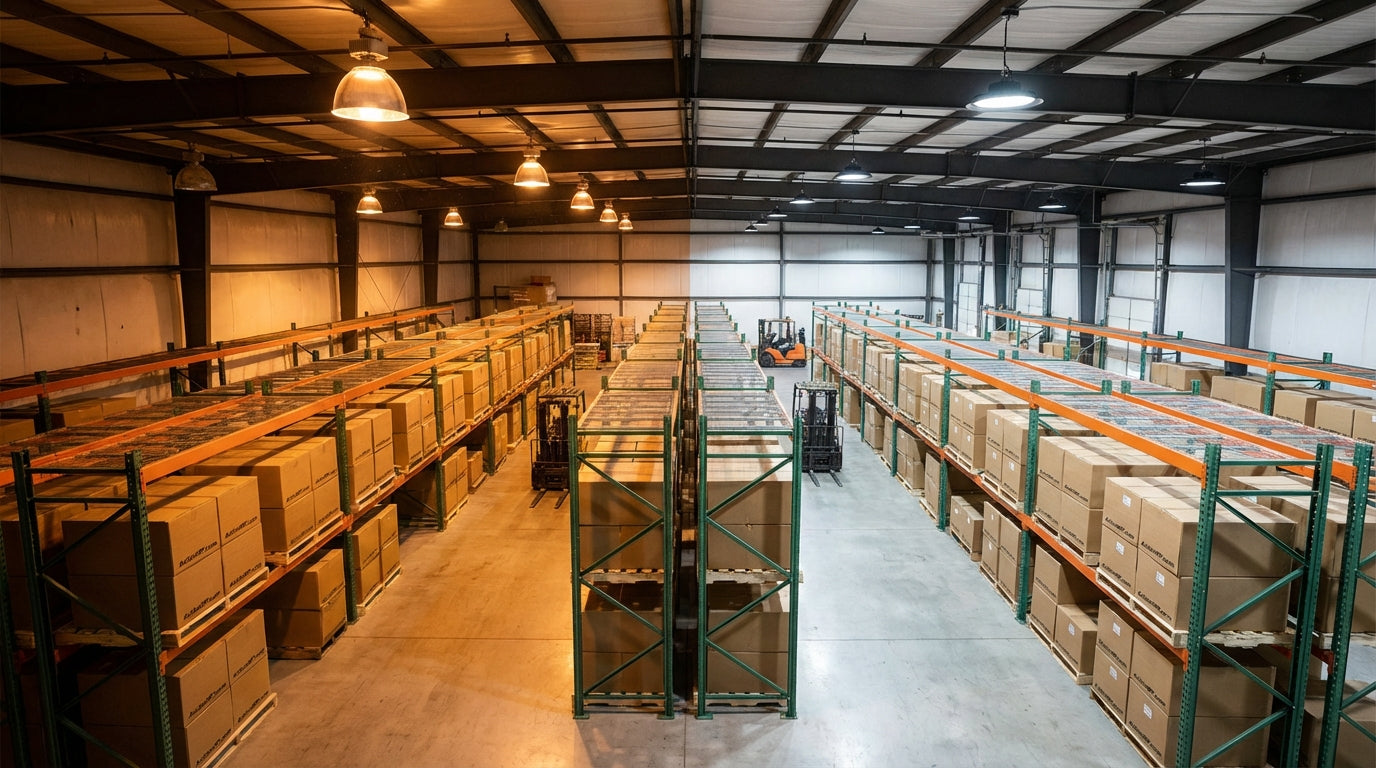
If you manage a warehouse or industrial facility, you are likely fighting a losing battle against Lumen Depreciation.
Consider the standard 400W Metal Halide (MH) bulb. On day one, it burns bright. But due to the chemistry of High-Intensity Discharge (HID) lighting, that bulb loses roughly 40% of its light output within the first 6-9 months, yet it continues to draw 100% of the electricity (plus an extra 15% for the ballast). You are effectively paying full price for half the light.
The solution is clear: metal halide to LED conversion. But the path to get there splits in two.
What is Metal Halide to LED Conversion?
A metal halide to LED conversion is the strategic upgrade of High-Intensity Discharge (HID) lighting systems to Solid State Lighting (LED). This is achieved via two primary methods:
- Retrofitting: Bypassing the legacy ballast to install an LED engine (like a Magnetic Kit or Corn Lamp) inside the existing housing.
- Full Replacement: Completely removing the legacy fixture to install a dedicated integrated LED luminaire (such as a UFO High Bay).
This upgrade typically yields energy savings of 60-75%, eliminates warm-up times, and stabilizes maintenance budgets.
This guide analyzes the math, labor, and thermal physics behind both options to help you decide whether to salvage your old fixtures or scrap them for something new.
II. The Core Comparison: Retrofit Kits vs. Integrated Fixtures
The decision between retrofitting and replacing hinges on the condition of your existing "housing"—the metal shell currently hanging from your ceiling.
📺 Related Video: Metal Halide vs LED High Bay retrofit comparison
1. The Retrofit Route (Keeping the Shell)
Retrofitting involves removing the internal components of your current fixture—specifically the heavy magnetic ballast and the capacitor—and wiring mostly "driverless" or driver-external LED components directly to the line voltage (120V-277V).
- The Technology: This category includes screw-in "Corn Lamps," "Paddle" bulbs, and commercial-grade solutions like the 4ft Magnetic Linear LED Retrofit Kit.
- The Process (Ballast Bypass): You must cut the wires to the ballast. This is non-negotiable. Running LEDs off an old HID ballast is a recipe for flickering and early failure.
- Ideal Use Case: Linear High Bays (T5/T8 style) or facilities where the aesthetic of the "Bell" reflector must be preserved for historical reasons.

2. The Full Replacement Route (New Engine, New Shell)
This involves physically taking down the old Metal Halide fixture and hanging a new integrated fixture, such as a LED UFO High Bay.
- The Technology: These fixtures use a die-cast aluminum heat sink that is engineered specifically for the LED diodes.
- The Advantage: Because the entire unit is new, you eliminate failure points like corroded sockets or cracked reflectors.
3. The "Thermal Trap": A Critical Warning
This is where most Facility Managers get burned (literally and financially).
Metal Halide bulbs like heat; they need it to vaporize the salts inside the arc tube. LED electronics hate heat.
When you screw a high-wattage LED "Corn Lamp" into a fully enclosed Metal Halide fixture, you create a Thermal Trap. The heat generated by the LED driver has nowhere to escape. Ambient temperatures inside the fixture can spike above 140°F (60°C), causing the driver’s capacitors to dry out.
The Engineering Rule:
- Open Fixtures: Retrofitting is safe.
- Enclosed Fixtures: Full replacement is statistically safer to prevent premature driver failure.
Metal Halide Conversion Matrix: Retrofit vs. Replace
| Attribute | LED Retrofit Kit (Magnetic/Screw-in) | Full Fixture Replacement (UFO/Linear) |
|---|---|---|
| Upfront Material Cost | Low ($30 - $80 per unit) | Medium ($80 - $200 per unit) |
| Labor Time | High (15-20 mins/unit for wiring) | Low (10-15 mins/unit for swap) |
| Thermal Management | Dependent on legacy housing (Risk of Heat Trap) | Superior (Optimized Heat Sinks) |
| DLC Rebate Potential | Tier 1 (Lower Incentives) | DLC Premium (Max Incentives) |
| L70 Lifespan | 50,000 Hours | 100,000+ Hours |
| Warranty | Typically 3-5 Years | Typically 5-7+ Years |
III. The Financial Attributes of Conversion (ROI & TCO)
To approve this project, your CFO needs to see the Total Cost of Ownership (TCO), not just the bulb price.

1. Operational Expenditure (OpEx) Reduction
The wattage delta is the primary driver of ROI.
- Legacy System: 400W Metal Halide + 58W Ballast Factor = 458 Watts total.
- LED Solution: A 400W equivalent LED High Bay typically draws 150 Watts.
- The Math: That is a 67% reduction in energy usage immediately.
2. The Hidden "Lift Cost"
Maintenance cycles are the silent budget killer. A Metal Halide bulb is rated for ~15,000 hours, but its useful life (L70) is often just 8,000 hours.
- Scenario: If your warehouse runs 24/7, you are changing bulbs every 12-18 months.
- The Cost: Renting a scissor lift costs between $250 and $500 per day in 2026.
- The LED Advantage: An LED fixture rated for 100,000 hours eliminates roughly 5 to 6 maintenance cycles. The savings on lift rentals alone often pay for the new fixtures.
3. Rebate Eligibility (DLC)
Utility companies incentivize "Permanent" upgrades.
- Full Fixtures: Often qualify for DLC Premium rebates because they are sealed, efficient systems.
- Retrofits: Screw-in lamps often qualify for lower tier rebates.
- Exception: High-quality kits like the Lumimuse 4ft Magnetic Retrofit are often DesignLights Consortium (DLC) listed, bridging the gap between convenience and rebate eligibility.
IV. Photometrics and Visual Acuity: The Hidden Variable
Energy savings are great, but light quality ensures safety.
CRI and Kelvin Temperature
Old Metal Halide lamps drift toward a greenish/pink hue as they age, often dropping below 60 CRI (Color Rendering Index). This makes it difficult for workers to read labels or identify color-coded wiring.
Upgrading to LED jumps the CRI to 80+, improving visual acuity. For industrial spaces, a color temperature of 5000K (Daylight) is the standard for alertness and clarity.
Beam Angles and Trapped Lumens
This is a physics problem. A Metal Halide bulb emits light omnidirectionally (360 degrees). It relies on a reflector to push that light down.
- The Retrofit Risk: If you put an LED bulb inside a dirty, oxidized reflector, you lose 20-30% of your lumens before they even leave the fixture.
- The Replacement Win: A new UFO High Bay uses polycarbonate optics to focus 100% of the light directly to the floor (usually in a 90° or 120° beam angle), wasting zero energy illuminating the ceiling dust.
For a deeper dive into how LED optics function, read our guide on Understanding LED Technology.
V. The Verdict: When to Retrofit and When to Replace
Not every facility is the same. Use these scenarios to dictate your strategy.

Scenario A: When to Retrofit
- Linear Fixtures: If you have 4ft or 8ft fluorescent/MH linear high bays, a Magnetic Retrofit Kit is brilliant. It attaches directly to the metal pan, using the fixture's own steel as a heat sink.
- Budget Constraints: If capital expenditure (CapEx) is tight but you have in-house electricians, retrofitting trades lower material costs for higher internal labor.
- Specialty Aesthetics: In retail or historic lofts where the "Industrial Look" of the old dome is required.
Scenario B: When to Replace (The Recommended Path)
- High Ceilings (>20ft): The lift rental costs are too high to risk a retrofit failure. Install a 100,000-hour rated UFO fixture and forget about it for a decade.
- High Ambient Heat: Warehouses in hot climates or manufacturing plants. Integrated fixtures have superior thermal dissipation.
- Maximum Rebates: If your local utility offers massive incentives for DLC Premium fixtures, replacement often becomes cheaper than retrofitting.
The Decision Checklist:
- [ ] Is the existing fixture housing rusted or cracked? (If Yes -> Replace)
- [ ] Are the ceilings higher than 25 feet? (If Yes -> Replace)
- [ ] Do you have linear fluorescent high bays? (If Yes -> Retrofit with Magnetic Kit)
- [ ] Is the facility strictly climate-controlled? (If Yes -> Retrofit is safe)
VI. Conclusion
The debate between retrofitting and replacing is ultimately a calculation of risk versus reward.
Retrofitting offers a lower barrier to entry and is an excellent choice for linear fixtures or controlled environments. Products like the 4ft Magnetic Linear LED Retrofit Kit allow you to upgrade existing housings with 4680 lumens of efficiency without creating waste.
Replacing, however, wins on Total Cost of Ownership for most high-bay industrial applications. By installing a dedicated fixture, you maximize thermal management, optical control, and rebate potential.
Ready to calculate your savings?
Don't guess with lighting. Whether you choose a magnetic retrofit or a UFO high bay, the goal is the same: eliminate the ballast, stop the energy bleed, and banish the buzz of metal halide to LED conversion forever.
What Users Are Saying
"We switched our fabrication shop from 400W MH to UFO High Bays. The difference isn't just the electric bill—it's the silence. No more buzzing ballasts." — Mark T., Facility Director, Ohio
"For our aisle lighting, we used the Magnetic Linear Kits to keep the existing rows. Installation took 10 minutes per fixture." — Sarah Jenkins, Operations Lead