
For a Safety Inspector or Facility Manager, a lighting failure is rarely just a maintenance ticket—it is often a compliance breach, a production halt, or a critical fire and shock hazard. When auditing industrial environments, understanding the specific engineering nuances of Ingress Protection (IP) ratings is the first line of defense against costly equipment failure.
What is the difference between IP65 and IP67 lighting? IP65 lighting is "dust-tight" and engineered to withstand low-pressure water jets from any direction, making it the standard for general washdown areas. IP67 lighting is also "dust-tight" but provides protection against temporary immersion in water (up to 1 meter for 30 minutes). While IP67 offers superior submersion resistance, it is not inherently better than IP65 for environments subjected to high-pressure kinetic water sprays, a distinction critical for regulatory compliance.
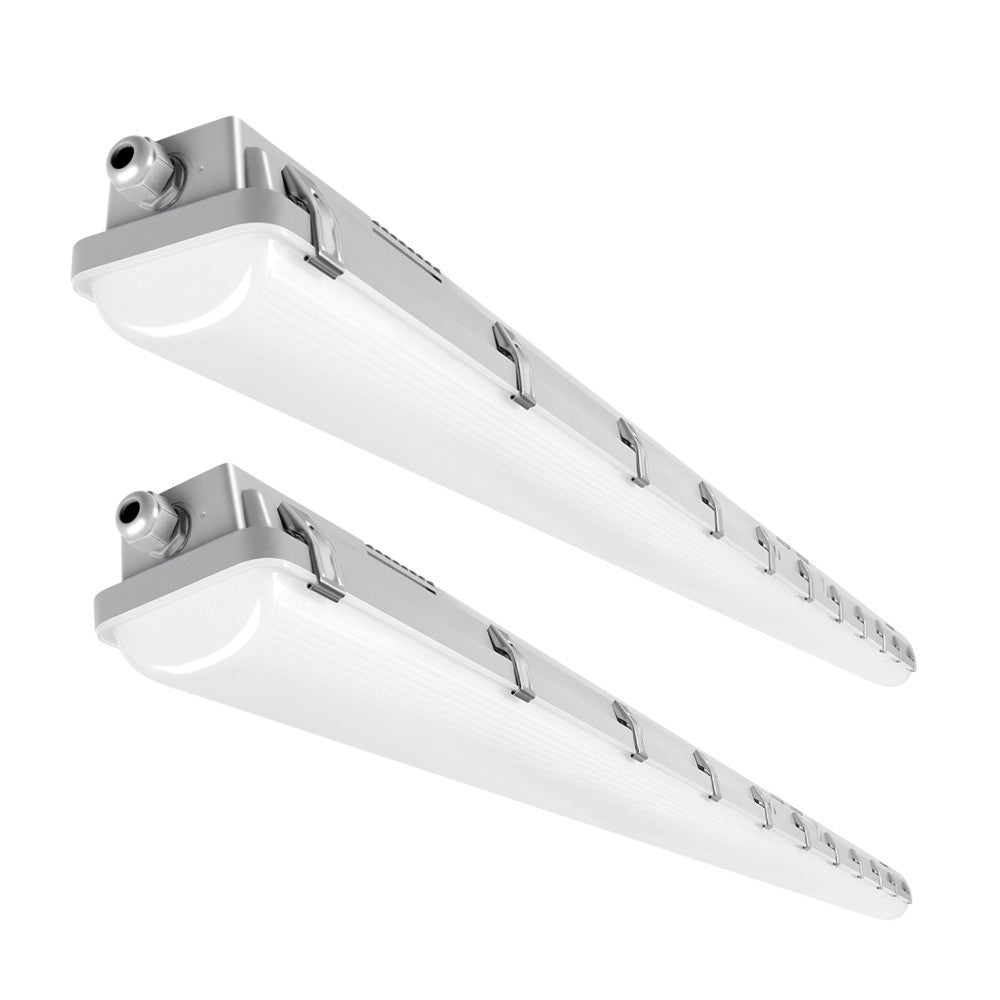
This guide deconstructs the IEC 60529 standard, analyzes the non-linear hierarchy of ingress protection, and explains why selecting the correct enclosure—such as the 8ft Vapor Tight LED Light Fixture—depends entirely on the nature of the fluid risk: hydrostatic pressure vs. kinetic force.

Decoding the IEC 60529 Standard: The Anatomy of an IP Rating
The IEC 60529 standard is an international classification system that grades the sealing effectiveness of electrical enclosures against the intrusion of foreign bodies and moisture.
To the untrained eye, a higher number implies superior overall protection. However, in the context of industrial physics, the second digit represents different types of protection rather than a linear progression of strength.
The First Digit: Solid Particle Protection
In both IP65 and IP67, the first digit "6" represents the highest level of dust protection. This indicates the enclosure is dust-tight, meaning no ingress of dust is permitted under a vacuum depression of 20 mbar for 8 hours. This is non-negotiable for grain elevators, wood processing plants, and textile mills where combustible dust is a concern.
The Second Digit: Liquid Ingress Protection
The second digit defines the device's defense against water. This is where the physics diverge.
| Rating Digit | Protection Type | Testing Protocol (IEC Standard) | Physical Stressor |
|---|---|---|---|
| 5 | Water Jets | 12.5 Liters/min via 6.3mm nozzle at 3m distance. | Kinetic Impact (Low Pressure) |
| 6 | Powerful Water Jets | 100 Liters/min via 12.5mm nozzle at 3m distance. | Kinetic Impact (High Pressure) |
| 7 | Temporary Immersion | Submersion up to 1 meter for 30 minutes. | Hydrostatic Pressure (Static) |
IP65 vs. IP67: Testing Protocols and Performance Gaps
Ingress testing protocols are rigorous laboratory procedures that simulate specific environmental stressors to validate the hermetic integrity of an industrial fixture.
A common misconception in facilities management is that an IP67 fixture is automatically compliant for IP65 or IP66 applications. This is false.
The "Dual Rating" Nuance
IP67 deals with immersion. It tests whether the seals can hold up against the crushing weight of water (hydrostatic pressure) when submerged.
IP65 deals with velocity. It tests whether the gasket can resist the kinetic energy of a water jet blasting directly at the seam.
A fixture designed for immersion (IP67) might rely on water pressure to help compress the seals. If that same fixture is hit with a high-velocity jet spray (IP65), the water could physically lift the seal edge and bypass the gasket. Therefore, unless a fixture is dual-rated (e.g., listed as IP65/IP67), a Safety Inspector should not assume it handles washdowns just because it handles puddles.
The Lumimuse Vapor Proof LED Fixture addresses these risks with a fully sealed housing and durable polymer clips, ensuring integrity against environmental moisture typical of commercial retrofits and parking garages.
The Inspector's Lens: Beyond the Rating
Enclosure integrity is the holistic measure of a fixture's ability to maintain its rating over time, factoring in material degradation, thermal dynamics, and chemical exposure.
When auditing a facility, checking the IP label is only step one. You must evaluate the environmental stressors that attack the rating itself.
1. Gasket Fatigue & Chemical Resilience
In food processing facilities, cleaning crews use caustic agents like chlorine or hydroxides. A standard silicone seal on an IP65 fixture might degrade if exposed to specific solvents, turning a "dust-tight" fixture into a sponge. The housing material matters. The 8ft Vapor Tight LED uses durable polymers for both the body and diffuser, offering impact resistance and chemical resilience superior to standard polycarbonate in certain acidic environments.
2. The "Breathing" Phenomenon
LED drivers generate heat. When a light turns on, the air inside expands; when it turns off, the air contracts. This thermal cycle creates a vacuum effect. If a fixture is IP67 (sealed against water) but lacks a pressure equalization vent, this vacuum can literally suck moisture through the microscopic pores of the cable gland or gasket. This is why "vapor tight" is a distinct category—designed to manage moisture in the air, not just liquid water.
For large-scale installations, consider how this integrates with broader systems like LED High Bay Lighting in warehouse zones where humidity fluctuates drastically.
Environmental Selection Logic: Matching Rating to Risk
Environmental selection logic is the strategic process of aligning fixture specifications with the specific hazards of a workspace, prioritizing failure mode mitigation over raw performance numbers.
| Environment | Primary Risk | Recommended Rating | Inspector Note |
|---|---|---|---|
| Car Washes | High-pressure spray, soaps | IP66 or IP69K | IP67 may fail if jets are directed at seals. |
| Food Processing | Sanitation washdown | IP66 / Vapor Tight | Look for NSF certification if near food zones. |
| Parking Garages | Exhaust fumes, humidity | IP65 | Focus on dust-tight seals to prevent lens darkening. |
| Flood-Prone Basements | Standing water | IP67 | Only use if temporary submersion is a genuine risk. |

Hazardous Locations and NEMA Cross-Reference
While IP ratings are global, North American inspectors often work with NEMA types. Generally, an IP65 enclosure is comparable to NEMA 4, while IP66/67 pushes into NEMA 4X territory (requiring corrosion protection). For areas with flammable gases, standard vapor tights may not suffice; you would need fixtures rated for Hazardous Locations (Class I, Div 2). However, for general commercial use—like retrofitting a shopping center canopy—the LED UFO High Bay Lights or the 8ft Vapor Tight are the compliant standard.
Conclusion: Spray vs. Stay
The rule of thumb for the safety inspector is simple: IP65 is for spray; IP67 is for stay.
If your facility is cleaned with hoses, prioritize IP65 or IP66. If your electrical infrastructure is in a pit that floods, mandate IP67. Blindly choosing the higher number can lead to gasket failure under washdown pressure. Always audit the environment first.
For versatile, durable protection in car washes, garages, and industrial refrigeration, the Lumimuse 8ft Vapor Tight LED Light Fixture offers a balanced, high-performance solution that meets the rigorous demands of modern facility compliance.