
In the world of life safety inspections, the "pass/fail" moment isn't determined by the fixture's aesthetic—it's determined by the NFPA 101 Life Safety Code. For Building Inspectors and Facility Managers, the bottleneck often isn't the repair itself, but the Audit Velocity—how quickly you can verify code compliance across a facility with hundreds of units.
This guide analyzes the two dominant players in the commercial sector—Lithonia Lighting (Acuity Brands) and Sure-Lites (Cooper Lighting)—through the lens of code compliance, specifically focusing on UL 924 standards, battery chemistry, and self-diagnostic (SD) audit speed.
I. Introduction
The pressure to maintain life safety compliance is escalating. With OSHA 1910.37 increasing scrutiny on egress paths and insurance carriers demanding stricter adherence to NFPA 70 (NEC), a single failed 90-minute test can ground a facility’s operations.
The burden falls on the inspector to cross-reference hardware durability against strict failure points. You aren't just looking for a light that turns on; you are verifying UL 924 listed equipment that guarantees an average of 1.0 foot-candle of illumination along the path of egress for a minimum of 90 minutes.
What are the primary emergency lighting code requirements?
According to NFPA 101 Section 7.9, emergency lighting systems must:
- Activate within 10 seconds of power loss.
- Provide an initial illumination of 1.0 foot-candle (avg) along the path of egress.
- Maintain a minimum of 0.6 foot-candle at the end of the 90-minute discharge.
- Possess a maximum-to-minimum illumination uniformity ratio not exceeding 40:1 (to prevent blinding glare/dark spots).
Below, we dissect how Lithonia and Sure-Lites hardware expedite or hinder this verification process.
II. The Hardware vs. The Code: Housing and Installation Compliance
When auditing a warehouse or industrial corridor, the first failure point is often physical damage to the housing. Code compliance requires equipment to withstand the environment it is installed in (e.g., damp locations, high-impact zones).
Housing Durability & NEMA Ratings
- Lithonia (Quantum Series): Known for its thermoplastic housing with a UL 94-5VA flame rating. The 5VA rating is critical; it indicates the material acts as a fire retardant and will not drip flaming particles. This is the industry standard for indoor commercial spaces (schools, offices).
- Sure-Lites (SEL Series): Often utilizes a mix of thermoplastic and die-cast aluminum options for higher-end models. For inspectors, the Sure-Lites polycarbonate lens integration typically offers higher Impact Protection (IK ratings), making them preferable in gymnasiums or low-ceiling corridors where vandalism is a risk.

The "Contractor Factor" & J-Box Compatibility
Improper mounting is a frequent code violation (NEC 110.12 "Mechanical Execution of Work"). If a fixture leaves gaps exposing the J-Box, it fails inspection.
- Lithonia: Features a "Quick-Mount" snap-fit design. While fast for contractors, inspectors must verify the "click" engagement to ensure the unit doesn't sag over time, breaking the ground connection.
- Sure-Lites: Uses an "EZ Hang" feature. The mechanical securement here is often more rigid, reducing the "sag" seen in older retrofits.
Comparison: Housing Compliance Specs
| Feature | Lithonia ELM2L (Typical) | Sure-Lites SEL (Typical) | Konlite LED Emergency Light |
|---|---|---|---|
| UL Listing | UL 924, Damp Location | UL 924, Damp Location | UL 924, Damp Location |
| Flame Rating | UL 94-5VA (Thermoplastic) | UL 94-5VA (Polycarbonate) | Thermoplastic (Impact Resistant) |
| Mounting | Quick-Mount Backplate | EZ Hang / Universal J-Box | Universal J-Box Pattern |
| Lamp Heads | Track & Swivel | Adjustable Optic | Fully Adjustable / Glare-Free |
| Primary Use | Commercial / Office | Commercial / Industrial | Corridor / Retrofit |
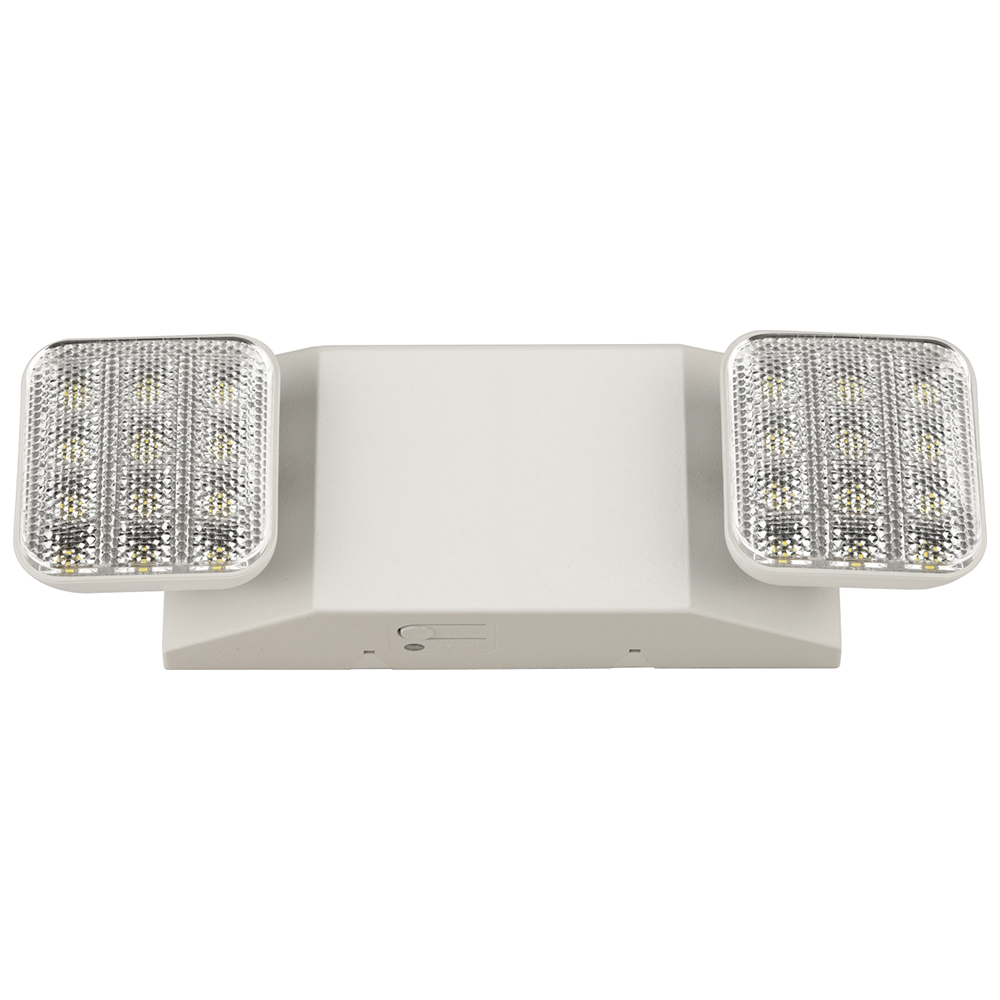
Pro Tip: For standard commercial retrofits where budget and compliance speed are paramount, the Konlite LED Emergency Light offers a compliant, flame-retardant thermoplastic housing that meets the UL 924 standard without the complexity of higher-tier systems.
III. Battery Chemistry & The "90-Minute" Mandate
NEC 700.12 mandates a 90-minute discharge. The chemistry of the battery dictates the reliability of this curve over the fixture's 5-7 year lifespan.

Discharge Curve Analysis
- Lithonia (NiCad): Most standard Lithonia units rely on Nickel-Cadmium (NiCad). NiCad is robust but suffers from "memory effect" if not cycled properly. In cold climates (unconditioned warehouses), NiCad performance drops significantly below 32°F (0°C) unless equipped with a specific heater package.
- Sure-Lites (LiFePO4): Sure-Lites has aggressively pivoted toward Lithium Iron Phosphate (LiFePO4) in their newer "High Power" (HP) series. LiFePO4 provides a flatter discharge curve, meaning the light stays brighter for longer during the 90-minute test, rather than dimming linearly like NiCad.
📺 Related Video: Emergency lighting battery discharge testing NiCad vs LiFePO4
Voltage Drop & Remote Capacity
Inspectors must verify "Remote Capacity"—the ability of the main unit to power external heads.
- Voltage Integrity: On long runs (e.g., 50ft+), voltage drop can cause remote heads to dim below the 0.1 fc minimum.
- The Verdict: Sure-Lites' LiFePO4 models generally sustain higher voltage output late in the discharge cycle, supporting remote heads better than equivalent NiCad models. However, for standalone applications, a standard NiCad unit like the Konlite 2.4W model provides reliable, dedicated illumination for the immediate area.
IV. The Inspector's Lens: Self-Diagnostics & Testing Verification
This is where Audit Velocity is won or lost. Instead of dragging a ladder to every fixture to push a test button, inspectors look for Self-Testing/Self-Diagnostic (SD/ST) status LEDs.
Decoding the Status Indicators (UI Analysis)
-
Sure-Lites "Eagle Eye":
- Interface: Uses a tri-color LED (Green/Red/Yellow).
- Advantage: The Steady Yellow indicator specifically denotes "Testing in Progress." This prevents inspectors from failing a unit that is simply in the middle of a monthly automated test.
- Failure: A Blinking Red indicates failure.
-
Lithonia "Quantum" / "Star":
- Interface: Typically a single bi-color LED (Green/Red).
- Advantage: Simplicity. Green is good, Red is bad.
-
Disadvantage: Troubleshooting requires counting blinks.
- 1 Blink: Electronics
- 2 Blinks: Battery
- 3 Blinks: Lamp
Quick-Reference LED Status Codes for Inspectors
-
Lithonia:
- 🟢 Solid Green: Float Charge (Normal)
- 🔴 1 Red Flash: Electronic/Transfer Failure
- 🔴 2 Red Flashes: Battery Failure
-
Sure-Lites:
- 🟢 Pulsing Green: High-Rate Charge (Normal)
- 🟡 Steady Yellow: 30-Second Test (Do not fail)
- 🔴 2 Red Blinks: Battery Failure
- 🔴 3 Red Blinks: Circuit Failure
Audit Note: For facilities utilizing manual testing protocols (monthly push-button tests), simpler units like the Konlite LED Emergency Light feature a standard push-to-test switch that provides immediate verification of battery transfer switches without complex coding.
V. Photometrics and Path of Egress Spacing
NFPA 101 dictates the spacing. If fixtures are placed too far apart, the floor light drops below 0.1 fc, creating a "dark spot" violation.

Center-to-Center Spacing
- Lithonia: Optimizes for standard corridor widths (6ft). Their linear lens design throws light effectively down long, narrow hallways (up to 33ft spacing on select models).
- Sure-Lites: The "AccuLED" optics allow for adjustable beam spreads. This is superior for wide-open spaces (like open-plan offices) where light needs to be thrown in a 360-degree distribution.
- Glare and Uniformity: Both brands manage the 40:1 uniformity ratio well, but Sure-Lites often edges out with better optical control to prevent "hot spots" directly under the fixture.
Integration with High-Ceiling Applications
In warehouses where ceiling heights exceed 20ft, standard wall-packs fail to reach the floor with 1.0 fc. This is where you integrate emergency packs with LED High Bay Lighting. A compliant system often pairs low-level emergency units (like the Konlite) for immediate path lighting, while LED UFO High Bay Lights with emergency battery backups handle the general area illumination.
VI. Conclusion
For the Building Inspector, the choice between Lithonia and Sure-Lites often comes down to the specific audit environment.
- Choose Sure-Lites (LiFePO4 models) if auditing a facility with extreme temperature fluctuations or requiring wide-area spacing. The tri-color LED interface speeds up visual inspections.
- Choose Lithonia for standard commercial corridors where replacement parts (NiCad batteries) need to be universally available and affordable.
However, for contractors needing a reliable, code-compliant workhorse for standard 120/277V applications, the Konlite LED Emergency Light serves as a robust "Source of Truth" for compliance. With fully adjustable glare-free heads and a UL-compliant thermoplastic housing, it ticks every box for the NFPA 101 inspection checklist without the premium markup of self-diagnostic proprietary systems.
Verify your compliance. Test your batteries. Keep the path of egress clear.