
Is saving $20 on a budget exit sign worth a $500 Fire Marshal fine?
For facility managers and business owners, the "cheap" exit sign is often a trap. The initial purchase price is negligible compared to the labor cost of installation and the regulatory headache of a failed inspection. When you are equipping a commercial space, you aren't just buying a plastic box with lights; you are buying UL 924 Compliance and NFPA 101 Life Safety assurance.
In the commercial lighting sector, two titans dominate the specification sheets: Lithonia Lighting (an Acuity Brands company) and Compass (a Hubbell/Current brand). Both offer compliant LED Exit Signs and Emergency Light Combos, but they serve different "Entity" needs in the market.
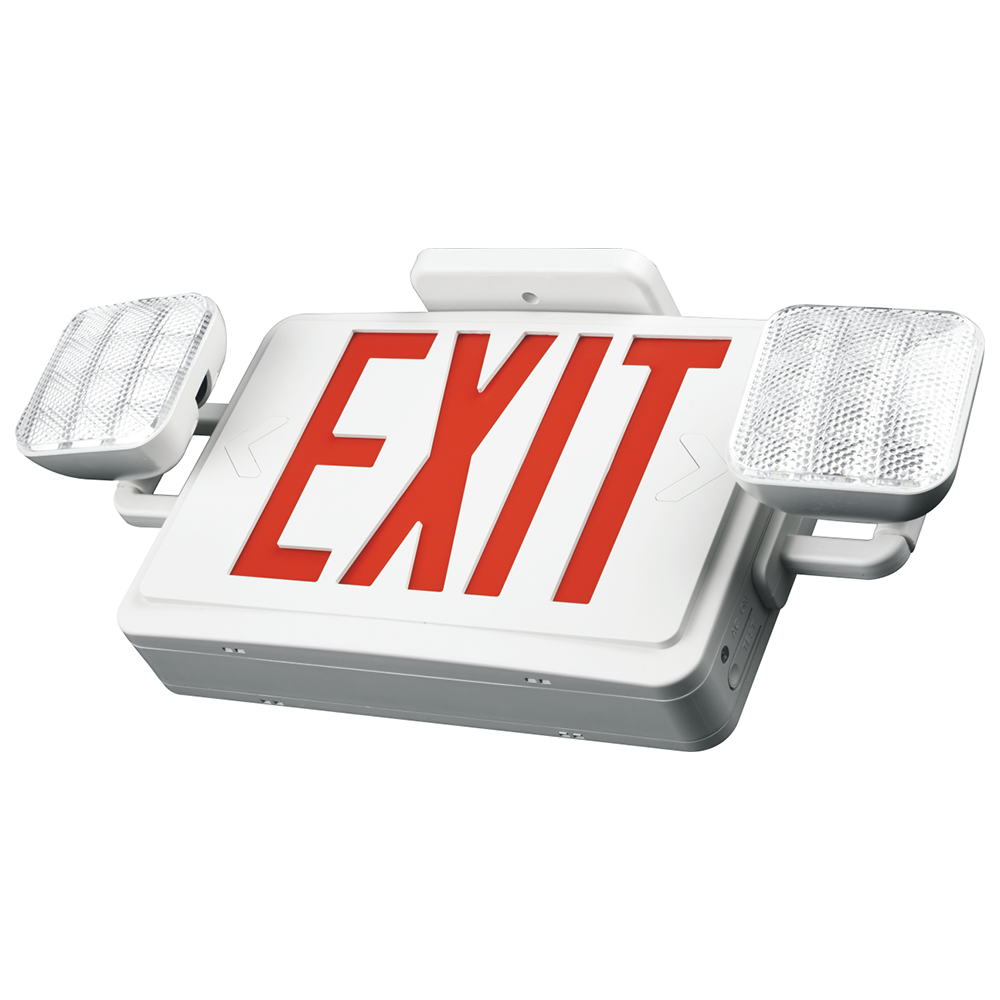
Quick Verdict: When comparing LED exit sign reviews for commercial compliance, Lithonia Lighting (LQM Series) is the "Retrofit King," preferred for its patented Quantum snap-fit mounting system that reduces electrician labor hours. Compass (CCR Series) is the "New Construction Value Leader," winning on upfront material costs for bulk orders. However, modern "Universal" options—like the Konlite LED Exit Emergency Light Combo—are disrupting this duopoly by offering Red/Green Selectable lettering in a single SKU, eliminating ordering errors.
The Compliance Baseline: What Your Inspector Checks
Before we dissect the brands, we must define the Attribute Entities that determine if you pass or fail an inspection. A compliant exit sign is not defined by its brand, but by its adherence to specific safety standards.
1. UL 924 & The 90-Minute Rule
The Underwriters Laboratories (UL) 924 Standard is the non-negotiable benchmark. It dictates that in the event of a power failure, your exit sign’s Battery Backup (typically Nickel-Cadmium) must power the illumination for a minimum of 90 minutes.
- Inspector Check: They will push the "Test" button. If the lights flicker or dim significantly within seconds, you fail.
2. Luminance & Uniformity
NFPA 101 (Life Safety Code) mandates that the letters be at least 6 inches high with a 3/4-inch stroke. But more importantly, the LED Illumination must be uniform. To understand why uniformity matters, it helps to look at LED Technology in Commercial applications. Cheap, generic imports often suffer from "hot spots" (bright LEDs visible through the plastic) or dark corners. Both Lithonia and Compass use high-quality diffusers to ensure the word "EXIT" is legible from 100 feet away.
3. Input Voltage Duality
Commercial buildings in the US operate on two primary voltage standards for lighting circuits: 120V (standard office/retail) and 277V (industrial/large commercial).
- The Trap: Buying a residential-grade sign that only supports 120V.
- The Solution: Both Lithonia and Compass standard units are Dual-Voltage (120/277V), preventing blown transformers during installation.

Head-to-Head: Lithonia LQM vs. Compass CCR
This comparison focuses on the industry workhorses: the Lithonia Quantum (LQM) series and the Compass CCR series. These are the "Combo" units (Exit Sign + Emergency Lights) found in 80% of commercial buildings.
Lithonia LQM (The Electrician's Favorite)
Lithonia positions the LQM as a premium thermoplastic unit. Its core "Entity Relationship" is with Labor Savings.
- Attribute - Housing: Made from impact-resistant, engineering-grade Thermoplastic. It resists yellowing from UV light better than cheaper competitors.
- Attribute - Mounting: Features the patented "Quantum" Quick-Mount system. The canopy snaps into the housing without tools, and the wire management is internal.
- Verdict: You pay more upfront (~$40-$70), but your electrician spends 10 fewer minutes per sign. On a 50-unit job, that saves an entire day of labor.
Compass CCR (The Budget Contender)
Compass (Hubbell) targets the "Value Engineering" sector.
- Attribute - Form Factor: The CCR series is marketed for its Compact Design. It uses a UV-stabilized thermoplastic that is lighter and slightly smaller than the LQM.
- Attribute - Economy: It strips away bells and whistles to hit a lower price point (~$25-$45).
- Verdict: Ideal for new construction where walls are open and wiring space is plentiful. The cost savings add up on massive bulk orders (e.g., warehousing).
Comparison Matrix: Technical Specs
| Feature | Lithonia LQM Series | Compass CCR Series | Lumimuse Konlite Combo |
|---|---|---|---|
| Housing Material | Impact-Resistant Thermoplastic | UV-Stabilized Thermoplastic | Injection-Molded Thermoplastic |
| Mounting Topology | Quantum Snap-Fit (Tool-less) | Universal Canopy | Universal J-Box Pattern |
| Letter Color | Red or Green (Specific SKUs) | Red or Green (Specific SKUs) | Selectable (Switchable) |
| Battery Chemistry | Nickel-Cadmium (NiCad) | Nickel-Cadmium (NiCad) | NiCad (90+ Min) |
| Lamp Adjustability | Full Range | Fully Adjustable | 360° Rotation |
| Best Application | Retrofit / High-Traffic | Bulk Warehouse / New Build | Inventory Simplification |
Installation & Labor: The "Universal Mount" Reality
The spec sheet rarely tells the whole story. The "Installation" entity is where profit margins are made or lost.

The Wiring Trap (Compass Pain Point)
While the Compass CCR is compact, this can be a double-edged sword. "Compact" housing means less internal volume for wire management. If your junction box is crowded with 12-gauge commercial wiring, stuffing the connections into a slim Compass unit can be frustrating.
- Real-World Feedback: Installers often complain that "compact" units bulge away from the wall if the wiring isn't perfectly dressed.
The Color Selection Headache (Lithonia Pain Point)
Historically, you had to order Lithonia signs as specifically Red or Green. If a facility manager ordered 20 Red signs, but the local code requires Green (common in parts of Canada and US states like Oregon), the entire order had to be returned.
- The Solution: This is where the Konlite LED Exit Emergency Light Combo shines. It features Selectable Color Technology. A simple internal switch allows you to toggle the LEDs between Red and Green during installation. One SKU covers all code requirements, eliminating return shipping costs.
Pro-Tip: Always verify your building's input voltage before ordering. While most modern units are 120/277V compatible, ensuring your "Emergency Egress" circuit isn't on a legacy voltage is a critical first step.
Information Gain: The "Self-Diagnostic" ROI Calculation
Most LED exit sign reviews stop at the price tag. But as a business owner, you must look at Total Cost of Ownership (TCO).
The Hidden Cost of "Push-to-Test"
OSHA 1910.37 and NFPA 101 require two specific manual tests for every exit sign:
- Monthly: A 30-second functional test.
- Annually: A full 90-minute discharge test.
If you buy a standard "Manual Test" unit (Lithonia or Compass basic models), a human being must physically climb a ladder and hold the button or cut the breaker.
📺 Related Video: Exit sign testing procedures NFPA 101
The Math: Manual vs. Self-Diagnostic
- Labor Rate: $75/hour (Maintenance Technician).
- Time per Sign (Yearly): 1.5 hours (90 min test + 12 monthly checks + travel time).
- Annual Cost per Sign: $112.50 in labor.
The Insight: You spend more on testing the sign in Year 1 than the sign costs. Smart facilities managers are shifting toward Self-Diagnostic (SD) models. These units automatically run their own monthly and annual tests and flash a small LED indicator if the Battery or Lamp fails. While SD models cost $20-$40 more upfront, they eliminate 90% of the maintenance labor, achieving ROI in under 6 months.
Conclusion: Which Brand Keeps You Compliant?
Both Lithonia and Compass produce hardware that will pass a Fire Marshal's inspection on day one. They are safe, UL 924 Listed choices that far outperform unbranded "white box" imports found on consumer marketplaces.

- Choose Lithonia (LQM) if you are retrofitting an existing building and want the easiest possible installation to save on electrician bills.
- Choose Compass (CCR) if you are a contractor bidding on a massive new construction project where every dollar of material cost matters.
The Smart Third Option:
For facility managers who want to simplify inventory and avoid "wrong color" ordering mistakes, the Konlite LED Exit Emergency Light Combo offers a compelling middle ground. It combines the Selectable Red/Green lettering of premium models with the High-Impact Thermoplastic durability required for commercial compliance.
Ready to upgrade your facility's safety infrastructure?
Browse our full selection of LED High Bay Lighting and emergency solutions to ensure your egress paths are clear, compliant, and maintenance-free.