Choose outdoor LED light strips by comparing the complete kit against a measured route, rather than selecting a brand from a league table. Start with where the light will go, which parts will be exposed and how you want to control it. This guide provides a shortlist worksheet; it does not claim a hands-on product test or a best-performing brand.
Write a short buying brief
Sketch the illuminated section and the separate route back to power. Mark corners, access points and where you could put the controller and supply. Decide whether you need simple on/off, adjustable white light or colour effects, then ask the supplier to confirm those functions for the complete model code.
Compare the full proposed purchase: strip, matching supply and controller, any required hub, permitted accessories and installation work. An attractive tape-only price is not yet the cost of your planned system.
Use one documented example to test the shortlist
The UK Hue Lightstrip Outdoor page for EAN 8718699709938 lists cut-ability and extendibility as No. Its setup FAQ requires a Hue Bridge and Hue app. These are model-specific documentary facts, not a recommendation, proof of current stock or a rule for every Hue strip.
| Comparison question | Documented Hue example | Record for another candidate |
|---|---|---|
| Can the lighted section be altered? | Cut: No. Extend: No. | Exact permitted changes and manual reference |
| What control equipment is needed? | Hue Bridge and Hue app in the cited FAQ | Controller, hub, account and supported functions |
| Where may each part go? | Check each component's own instructions | Strip, controller, supply and connections separately |
| Does the proposal fit the route? | Review the unmodified kit dimensions | Lit length, unlit leads, corners and access |
| What is the complete purchase? | Confirm the actual supplied package | All required parts and installation cost |
A fit decision before a purchase
Hypothetical example: you want light along a 3.2 m railing and a shortlisted model cannot be cut. The decision is to find an allowed layout or a different documented model, not to assume scissors and a sealed end will solve the mismatch. Also record the unlit route to power; it is a separate measurement.
Compare exposure as well as the tape label
IP65 describes dust-tight and water-jet protection. An IP code does not establish every environmental limit, such as UV exposure, temperature or corrosion resistance. Read the exact component instructions and ask about the actual site; do not use a generic waterproof label as approval of a complete system.
Electrical Safety First's garden advice recommends RCD protection, suitable outdoor extensions and connectors, and switching off and unplugging before checks or adjustments. Refer uncertain fixed wiring or supply arrangements to a qualified electrician. This is consumer guidance, not an installation certificate.
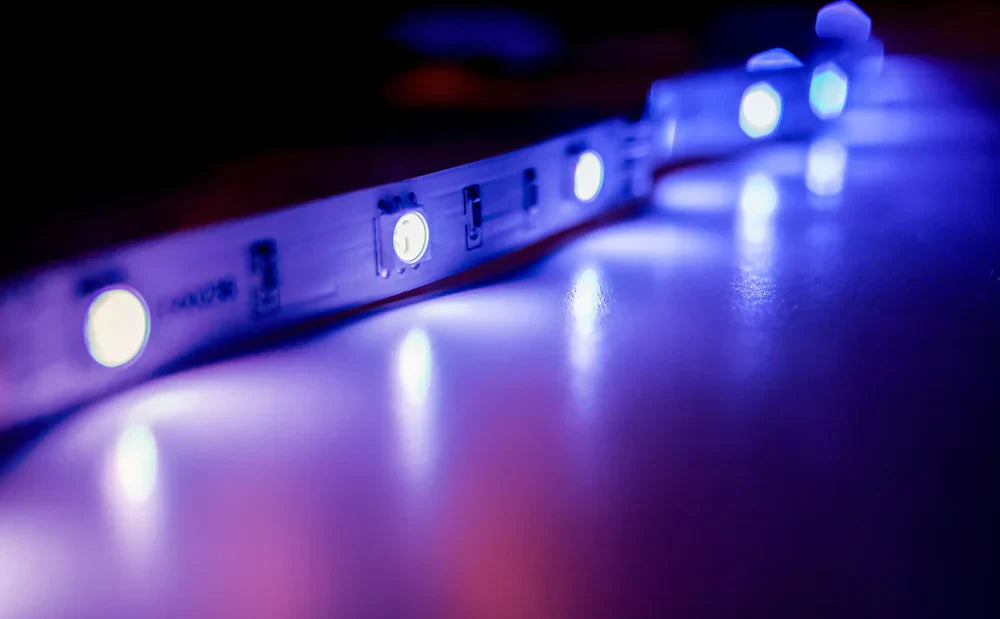
Image note: the close-up shows illuminated LED tape. It does not identify a tested outdoor model or prove water protection, heat limits or a permitted mounting method.
Take the shortlist to the next step
Keep unanswered fields as questions rather than filling them with a brand-level assumption. Use the outdoor strip buying checklist for the broader purchase review and the installation planning guide before any work.
Frequently asked questions
Which brand makes the best outdoor LED light strips?
A brand name alone is not enough to choose a kit. Compare the exact model, documented functions, permitted location, length and complete cost against your own route.
Can I shorten any outdoor LED strip to fit?
No. The documented Hue Lightstrip Outdoor EAN 8718699709938 is non-cuttable and non-extendible. Other models need their own explicit instructions; a cutting mark on another strip proves nothing about this one.
Does an IP rating on the strip cover the whole installation?
Check the rating and permitted location of every relevant part. The tape label does not establish the suitability of its controller, power unit, connectors or their arrangement.