The energy price cap changed on 1 October 2026, just as the evenings get dark enough to want the lights on by teatime. So it is a fair question to ask before you hang anything up: do fairy lights use a lot of electricity? The short answer is no. Modern LED sets are among the cheapest things in the house to run. Here is the maths at the current rate, how to check your own lights, and a few ways to keep the cost to pennies.
What is the electricity rate from October to December 2026?
Ofgem reviews the energy price cap every three months. For 1 October to 31 December 2026, the electricity unit rate under the cap is 26.32p per kilowatt hour (kWh). That figure is for a standard variable tariff paid by Direct Debit, averaged across England, Scotland and Wales. Your own rate depends on your region, how you pay and whether you are on a fixed tariff, so check your bill for the exact figure. Northern Ireland is not covered by the Ofgem cap.
You also pay a daily standing charge, but that is the same whether your lights are on or off. The only number that matters for fairy lights is the unit rate. The cap changes again on 1 January, so if you are reading this later, swap in the newer rate.
How much does it cost to run fairy lights?
One kWh is what a 1,000 watt appliance uses in an hour. Fairy lights use a tiny fraction of that, so the sum is simple:
watts ÷ 1,000 × hours used × unit rate = cost
The wattage is usually printed on the plug, the label near the plug, the adapter or the box. The table below uses example wattages at 26.32p per kWh, with the lights on for six hours every evening. Check the label on your own set and swap in the real number.
| Example set | Power | Cost per evening (6 hours) | Cost for 30 evenings |
|---|---|---|---|
| Small LED string | 3W | about 0.5p | about 14p |
| Medium LED string | 5W | about 0.8p | about 24p |
| Large LED set | 10W | about 1.6p | about 47p |
| Old filament-bulb set | 40W | about 6.3p | about £1.90 |
Another way to picture it: a 10W set has to run for 100 hours to use a single unit of electricity. That is more than two weeks of six-hour evenings for 26.32p.
Why do LED string lights use so little power?
Old fairy lights used tiny filament bulbs, which make light by getting hot. Most of the electricity went on heat. LEDs turn far more of it into light, so each one needs only a sliver of power, and they stay much cooler too.
USB-powered lights also have a ceiling on what they can draw. A typical USB socket supplies 5 volts at a modest current, usually somewhere between a few watts and around 15 watts depending on the port and plug. Even at the top of that range, a USB set running six hours a night costs only a couple of pence.
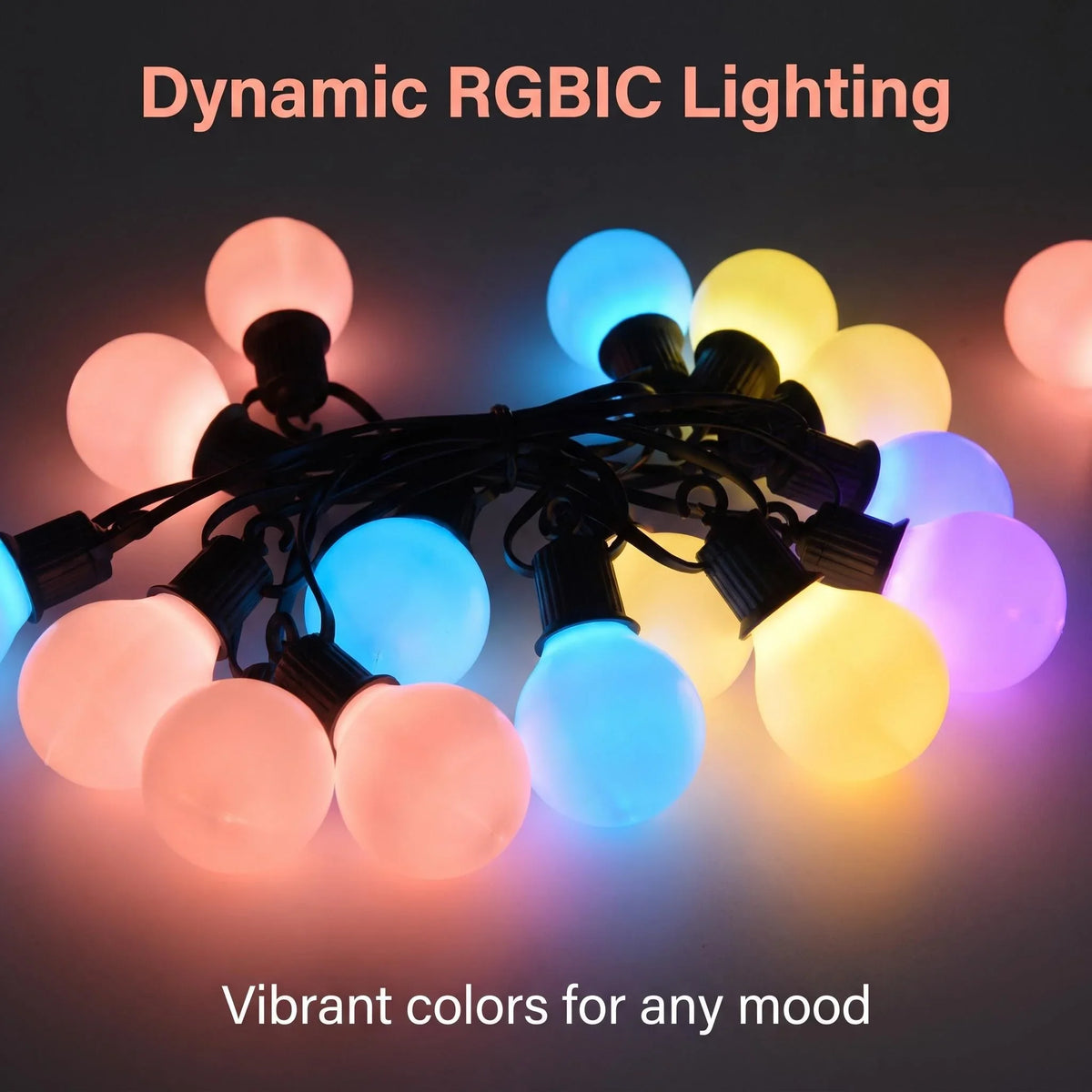
Colour-changing sets work the same way. Our Decorative Festoon Bulb String Lights, a string of globe-style bulbs with colour settings, app control and music effects, still come down to the same sum: check the power input on the label and use the formula above.
If you still have a box of old filament lights in the loft, they are the one type worth replacing. As the table shows, they can cost several times more to run than an LED set of a similar size.
Four ways to run lights for even less
1. Watch out for standby power on smart lights
App-controlled lights need a small controller that stays awake listening for your phone. When you tap “off” in the app, the bulbs go dark but the controller usually keeps drawing a little power. It is a small amount, but it runs all day and all night. If you will not use the lights until tomorrow evening, switch them off at the plug.
2. Let the sun do the work
Solar lights charge from daylight and cost nothing to run. Our Star Waterfall Decorative Lights are listed in USB and solar versions, so check which version you are ordering. Be realistic about British winters: short, grey days mean less charge and a shorter glow. Before putting any light outside, check its instructions and weather-resistance rating for that spot.
3. Go cordless
A rechargeable light uses a little electricity to top up, then runs with no cable at all, which is handy for a shelf or table with no socket nearby. Our Colour Light Bulb is listed as a rechargeable design with a remote and colour or white-light settings. Follow the manufacturer's instructions for charging and where it can be used.
4. Use timers and the off switch
- Set a timer. If your set has one built in, on the remote or in its app, use it so the lights never run all night by accident. A plug-in socket timer does the same job for simple sets.
- Turn the brightness down. If your set lets you, a lower setting uses less power and is often cosier anyway.
- Switch off at the plug when you go out or go to bed.
Are cheap-to-run lights safer too?
Low running cost and safety often go together. LEDs run much cooler than filament bulbs, and USB, battery and solar lights work at low voltage. Whatever type you have, a few habits are worth keeping:
- Read the instructions and the label on the plug or adapter that comes with your lights, and use the power supply they were supplied with.
- Check the cable, plug and bulbs for damage before you hang them, and do not use a damaged set.
- Use a good-quality USB plug, and do not overload an extension lead.
- Only use lights outdoors if their instructions say they are suitable for outdoor use, and keep USB plugs and power banks somewhere dry.
- Switch lights off when you go to bed or leave the house.
A quick buying checklist
- LED, not filament. This is the single biggest saving.
- Power source. USB for flexibility indoors, solar for daylight-charged running, rechargeable for places with no socket.
- Wattage on the label. Lower is cheaper to run; use the formula above to compare.
- Standby. For smart lights, plan to switch off at the plug when they are not in use.
- Where it will live. Check the instructions and weather-resistance rating before anything goes outside.
Frequently asked questions
How much does it cost to leave fairy lights on all night?
Using the examples above, a 5W LED set left on for 12 hours uses 0.06kWh, which is about 1.6p at 26.32p per kWh. The cost is small, but it is still better to switch lights off, or use a timer, when you go to sleep.
Do smart fairy lights use electricity when they are switched off in the app?
Usually a little, because the controller stays connected so it can hear your phone. Switching off at the plug stops it completely.
Do solar fairy lights work in a UK winter?
They can, but for a shorter time each evening, because there are fewer daylight hours to charge the battery. Keep the panel clean, angle it towards the brightest part of the sky and keep it out of shade.
Is it cheaper to run fairy lights from USB or from the mains?
What matters is the wattage, not the plug. A USB set and a mains set that use the same number of watts cost almost the same to run. USB sets are limited in how much power they can draw, which is why they tend to be cheap to run.
Small lights, small bills
At this autumn's rate, an evening of LED fairy lights costs around a penny or two, so there is no need to sit in the dark to save money. Choose LED, use a timer, switch smart lights off at the plug overnight and let solar or rechargeable lights cover the spots with no socket. You can find festoon bulbs, star lights and more in our Party & Christmas Lights collection, with tracked delivery in 3 to 7 working days and 14-day returns.