LED grow lights for indoor plants should be compared using the light reaching the growing area, alongside the needs of the plants. Electrical wattage alone does not tell you how many plant-usable photons reach the leaves.
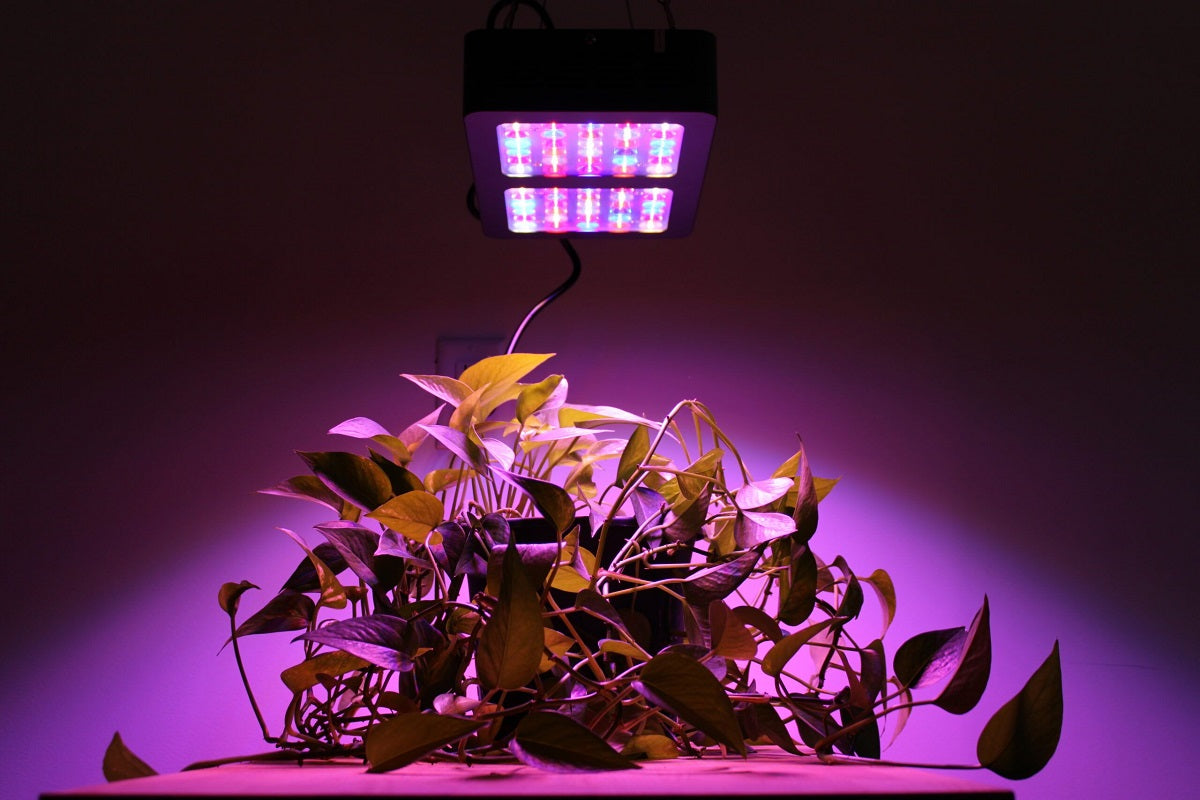
Cover image: an unidentified hanging light above a plant. It illustrates a setting, not a tested growing result, safe hanging distance, spectrum or installation method.
Start with one growing area
Suggested approach: write down the plant species, growth stage, shelf dimensions and available daylight before comparing fixtures. Find plant-specific guidance first. Ask for data for the exact model and intended arrangement, with the measurement height, lit area and dimmer setting stated.
Keep the question concrete: “Will this fixture provide the light my plants need across this shelf?” is more useful than choosing the largest advertised wattage or an unqualified “full spectrum” label.
Separate input, output and received light
Watts (W) describe electrical input power. Photosynthetic photon flux (PPF, µmol/s) describes photon output per second. Photosynthetic photon flux density (PPFD, µmol/m²/s) describes those photons reaching a receiving area each second. Daily light integral (DLI, mol/m²/day) adds the received light over a day. See Iowa State University Extension’s definitions and DLI guidance.
Use a shelf comparison sheet
Suggested worksheet: request or record values at leaf height across your intended area. Keep supplier measurements separate from your own observations; leave missing information blank rather than assuming the centre represents the whole shelf.
| Record | Candidate A | Candidate B |
|---|---|---|
| Exact model and dimmer setting | Model / setting / source | Model / setting / source |
| Distance and measured area | Height in cm; area in m² | Use the same comparison conditions |
| PPFD at left, centre and right | Three stated values, with method | Three stated values, with method |
| Daily duration and daylight | Planned hours; daylight assessed separately | Same plant requirement, stated assumptions |
If one seller gives a PPFD map and another gives only wattage, mark the second candidate as missing received-light evidence. That is a reason to ask a question, not proof that it performs worse.
A calculation with clear limits
For constant PPFD, DLI = PPFD × hours × 0.0036. Hypothetical example: 100µmol/m²/s for 12 hours gives 100 × 12 × 0.0036 = 4.32mol/m²/day.
These are invented inputs to demonstrate the arithmetic, not measurements of a listed fixture or a recommendation for any plant. The calculation covers artificial light only; it excludes daylight. Variable output would need to be accounted for rather than treated as constant.
Keep distance tied to the fixture and plant
Plant requirements, fixture position and distance affect received light. University of Minnesota Extension’s indoor-plant guidance discusses positioning. It does not turn a photograph or a generic LED label into a verified distance for your fixture.
Before buying, resolve missing positioning and operating instructions with the supplier. Do not infer suitability for humid or wet use from the words “grow light”. For a broader purchasing checklist, read our indoor grow-light buying guide; for comparing named candidates, use the exact-model comparison approach.
Questions before choosing
Does a higher wattage mean more light reaches my plants?
Watts describe electrical input, while PPFD describes plant-usable photons reaching an area each second. Compare PPFD data with the distance and area stated; wattage alone does not answer the received-light question.
How far should an LED grow light be from the leaves?
There is no single distance specified here. Plant requirements and fixture position matter. Use the exact fixture's instructions and relevant received-light data, rather than treating the cover photograph as a spacing guide.
Is 4.32 mol/m²/day a recommended target?
No. It is only the artificial-light contribution in the hypothetical constant-PPFD calculation above. It excludes daylight and does not establish the right daily light total or lighting schedule for a particular plant.