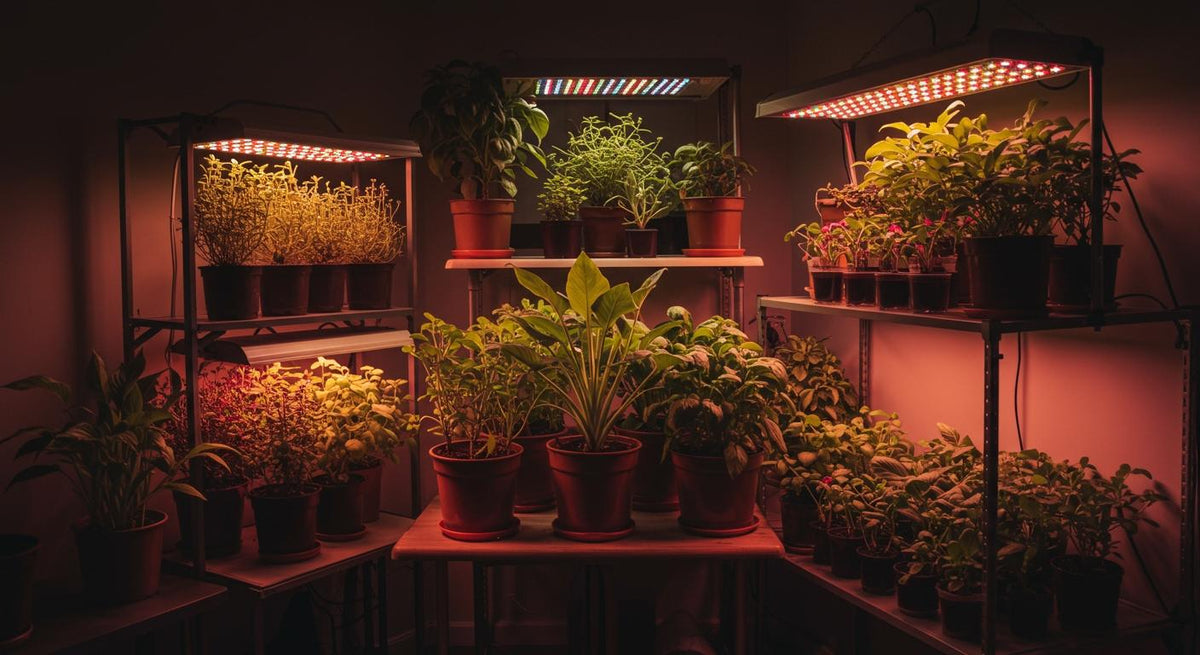
Image note: the cover is an illustrative indoor plant arrangement. It does not identify a Vivosun or Mars Hydro model and does not depict a comparative trial or measured result.
Vivosun vs Mars Hydro is useful only after you name the actual fixtures, versions and control bundles. This guide compares limited manufacturer documents, then gives you a worksheet for deciding what to ask next. It does not establish a whole-brand winner in light output, reliability or plant results.
Two references, with different input powers
The Vivosun AeroLight manual lists VSA100 at 100 W with an integrated circulation fan and documents control through specified GrowHub models. The Mars Hydro TS1000 page viewed for the 2026 update, SKU TS-1000-2510, labels it 150 W and says its Bluetooth-control iConnectu module is purchased separately.
| Exact document reference | What is established | What still needs checking |
|---|---|---|
| Vivosun AeroLight VSA100 manual column | 100 W input; integrated circulation fan; named GrowHub control route | Actual offered revision, controller bundle and UK supply |
| Mars Hydro 2026 TS1000 / TS-1000-2510 page | 150 W label; MarsPro control needs a separate iConnectu module | Offered revision, accessory inclusion and UK supply |
These references are not an equal-power test. The Mars source is a US manufacturer page and the Vivosun manual is not proof of a particular UK seller bundle. Neither identifies the supplied stock of this shop. Do not transfer their details to every FC, FC-E, VS or AeroLight product.
Make a fair useful-light comparison
PPFD describes photon delivery per unit area at the receiving surface; watts describe electrical input. Plant requirements and fixture placement matter. A higher headline number does not establish which fixture suits your entire plant area.
| Match this condition | Record for each exact fixture |
|---|---|
| Receiving area | Your occupied shelf/canopy dimensions and the same measurement grid |
| Position and setting | Height, orientation and dimming used for the published map or your own measurement |
| Useful result | Centre and edge readings, with the measurement method stated |
| Operating conditions | Room conditions and any other light sources present |
This is a comparison method, not a report of tests we performed. Ask suppliers for maps with their conditions, then reject comparisons that mix different areas or settings. No PPFD winner is assigned here.
Compare the complete control route
Vivosun’s manual names GrowHub E42A+, E42A and E25 in its connection instructions. Mars describes an optional iConnectu route for the referenced TS1000. Confirm the light revision, controller, required accessories and instructions as one package.
A connector that looks similar is not evidence that commands or wiring match. This guide verifies no cross-brand controller/adapter combination and no claim that one app is more reliable than another. Ask for a demonstration of the exact functions you need before treating a bundle as equivalent.
A transparent running-cost example
Hypothetical calculation: assume each fixture draws its labelled power continuously for 8 hours a day over 30 days. At 100 W that is 24 kWh; at 150 W it is 36 kWh. The difference is 12 kWh. At an illustrative 25p/kWh, that one input-power difference would cost £3 over the period.
The formula is watts × operating hours ÷1000, then kWh × your unit rate. These are assumed hours and an example tariff, not current UK prices, measured input or a plant schedule. Dimming and other equipment change consumption. A smaller electricity figure does not establish equal useful light or a better crop result.
Choose against your brief
First reject any proposal whose model or control bundle is unclear. Then compare the usable-light evidence, physical fit, operating functions, total delivered price and service terms for the same task. If the evidence is incomplete, request it rather than filling the gap with a brand reputation or an unsourced star rating.
Supplemental UVB is a separate equipment and exposure question. It is not a required upgrade established by this comparison.
Questions before buying
Does one brand always deliver more useful plant light?
No brand-wide advantage is established here. Compare exact fixtures at the same canopy area, height, dimming and measurement grid, using the plant requirements for your application.
Is smart control included with every light?
No. The viewed TS1000 page says its iConnectu module is separate. Vivosun control instructions apply to the named AeroLight/GrowHub combinations; confirm the exact offered bundle.
Must I add a UVB lamp to either LED light?
This comparison establishes no universal need for UVB or guaranteed benefit from it. Supplemental UV needs separate model, application and exposure evidence; it is not an automatic upgrade.
Related tools
The indoor plant-light guide helps define the task. Use the power worksheet for your actual inputs. If you are investigating UV, read the lamp identity and exposure checklist separately.
Editorial review: 20 October 2026. Sources are linked at the relevant passages. Documentary references do not establish physical stock, authenticity, UK approval or first-hand testing.