
For property managers, a dark parking lot isn't just a maintenance oversight—it's a massive liability magnet and a deterrent to high-value tenants. Whether you manage a retail complex or an industrial distribution center, the lighting you choose impacts safety, energy costs, and legal compliance.
Parking lot lighting standards are a set of technical guidelines established by the IESNA (Illuminating Engineering Society) and local municipalities to ensure safety, visibility, and energy efficiency. Key metrics include a minimum horizontal illuminance of 0.5 to 5.0 footcandles, a maximum-to-minimum uniformity ratio of 15:1 (or 4:1 for high-security areas), and strict adherence to BUG ratings to minimize light pollution.
In this guide, we break down the critical differences between industry giants RAB Lighting and Hubbell (now part of Current), and how modern solutions like the Vela I LED Parking Lot Light integrate these standards for maximum ROI.
The Core Benchmarks: IESNA Standards & BUG Ratings
IESNA RP-8-21 is the definitive recommended practice for design and maintenance of roadway and parking facility lighting. Adhering to this standard is the primary defense against slip-and-fall lawsuits and security negligence claims.
Illuminance vs. Uniformity
Many facility managers make the mistake of chasing "brightness" (high lumen counts) while ignoring uniformity. A lot with bright pools of light and dark shadows is actually more dangerous than a dimly lit, uniform lot. The eye struggles to adjust between extremes, creating "blind spots" where pedestrians disappear.
The IESNA RP-8-14 (and the updated RP-8-21) prioritizes the Uniformity Ratio—the ratio of the average light level to the minimum light level. A lower ratio means smoother lighting.
The BUG Rating System
BUG Ratings stand for Backlight, Uplight, and Glare. This classification system helps you choose fixtures that direct light only where it is needed (the ground) and prevents "light trespass" into neighboring residential properties or the night sky (Dark Sky compliance).
At-a-Glance Standards Table
| Activity Level | Typical Application | Min Horizontal Illuminance (fc) | Max:Min Uniformity Ratio |
|---|---|---|---|
| Low | Long-term storage, employee parking | 0.2 - 0.5 fc | 20:1 |
| Medium | Office buildings, retail strips | 1.0 - 2.0 fc | 15:1 |
| High | Major malls, stadiums, 24/7 retail | 2.0 - 5.0 fc | 15:1 (or 4:1 for Security) |
RAB Area Lights: Efficiency and Speed of Deployment
RAB Lighting is a manufacturer known for "Contractor-Friendly" design, prioritizing ease of installation and high luminous efficacy for rapid retrofit projects.
Attribute Focus: Luminous Efficacy
RAB has built its reputation on efficiency. Their "ALED" and "Lotblaster" series often push the boundaries of lumens-per-watt (lm/W), allowing property owners to replace 1000W Metal Halide fixtures with 200-300W LED equivalents. This drastic reduction in wattage directly impacts the bottom line, often cutting energy bills by 65-75%.
The "LOT5" Advantage
For central lot coverage, RAB utilizes specific Type V distribution optics. Unlike Type III (which pushes light forward from a perimeter), Type V throws light in a 360-degree circle. This is critical for large, open box-store parking lots where poles are centrally located.
Related Entity: Utility Rebates
Most RAB commercial fixtures carry the DLC Premium listing. This certification is a signal to utility companies that the fixture meets strict efficiency tiers, often unlocking rebates that can cover 20-40% of the initial hardware cost.
Hubbell (Current): Precision Optics for Complex Layouts
Hubbell Lighting (now integrated into Current) is a lighting conglomerate known for specification-grade optics and architectural durability, often favored for projects with complex zoning restrictions.
Attribute Focus: Light Distribution & Control
Hubbell’s legacy brands, such as Kim Lighting and Beacon Products, excel in "optical cutoff." If your parking lot borders a residential neighborhood with strict light trespass laws, Hubbell’s precision optics are engineered to "slice" the light at the property line, maintaining zero footcandles of spillover.
Durability and Thermal Management
Heat is the enemy of LEDs. Hubbell fixtures often feature over-engineered heat sinking designs. This superior thermal management ensures the LEDs maintain their L70 Lifespan (the time it takes to degrade to 70% brightness) even in extreme climates like Arizona summers or Canadian winters.
For facility managers overseeing multiple sites, Hubbell’s NX Lighting Controls offer a robust, wired/wireless hybrid ecosystem. However, for simpler retrofits, this level of control can sometimes introduce unnecessary complexity compared to RAB's "Lightcloud" system.

Strategic Decision: Choosing the Right Engine for Your Lot
Choosing between RAB, Hubbell, or a high-performance alternative comes down to your specific project constraints: Budget, Timeline, and Light Control.
- When to Choose RAB: Ideal for rapid retrofits where the primary goal is energy reduction and ROI. If you have a standard rectangular lot and need to get the job done quickly with readily available stock, RAB is a strong contender.
- When to Choose Hubbell: Better for architectural projects where the look of the fixture matters as much as the light. Also critical for sites with strict "Dark Sky" ordinances requiring absolute precision in light cutoff.
The High-Performance Alternative: Vela I Series
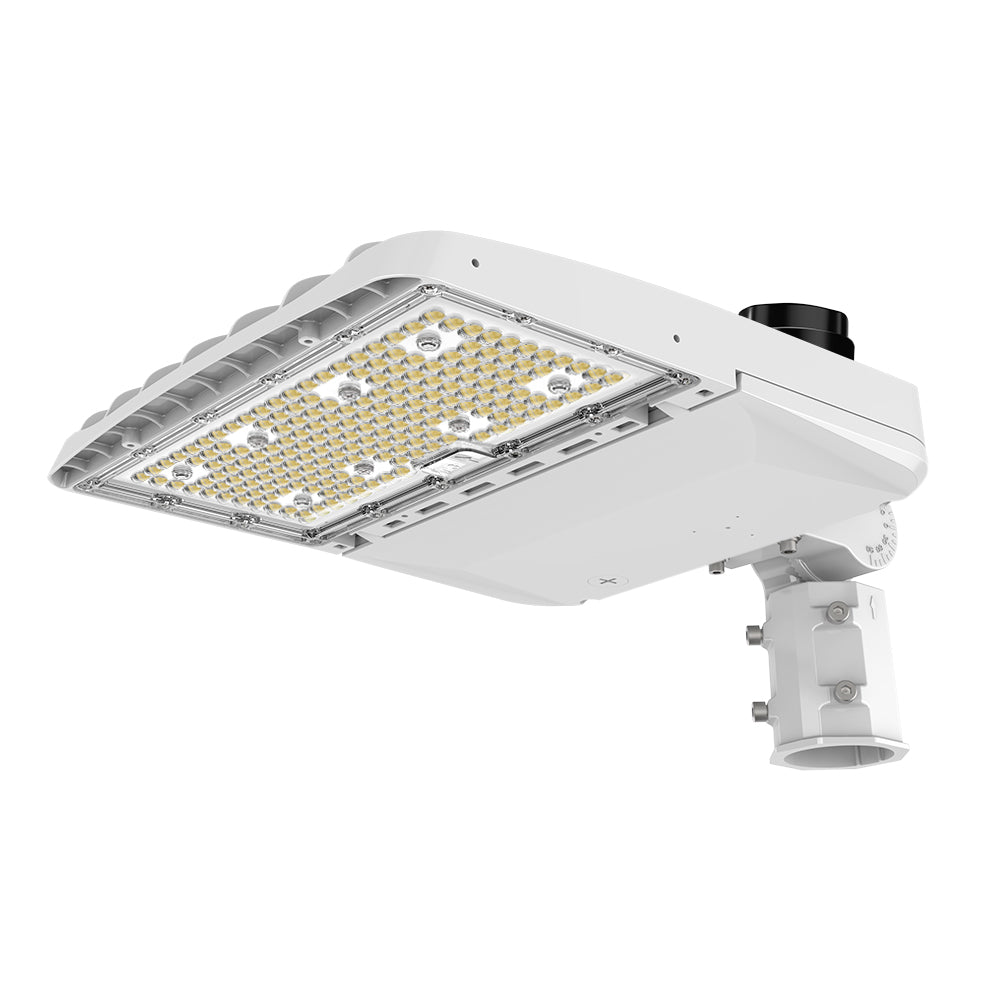
For many property managers, the "sweet spot" lies in a fixture that combines RAB's efficiency with specification-grade versatility. This is where the Vela I LED Parking Lot Light excels.

The Vela I LED is a LED Outdoor Flood Light equivalent that delivers 155 Lumens per Watt, rivaling top-tier RAB fixtures. It features a 4-Wattage Selectable Switch (150W/120W/100W/80W), allowing facility managers to fine-tune brightness on-site without ordering different SKUs. Its Type III distribution is standard for parking lot perimeters, ensuring wide lateral coverage without forward throw waste.
The Maintenance-Adjusted ROI
The cheapest fixture is often the most expensive to own. A "bargain" LED that fails in 3 years will cost roughly $500-$1,000 in bucket truck roll fees to replace. Investing in a fixture with 10KV Surge Protection (standard in the Vela I) and a 100,000-hour rated life protects your CAPEX budget for a decade.
| Feature | Standard HID (Legacy) | RAB AreaLight Series | Vela I LED Series |
|---|---|---|---|
| Luminous Efficacy | 60-80 lm/W | 130-150 lm/W | 155 lm/W |
| Lifespan (L70) | 20,000 Hours | 100,000 Hours | 100,000 Hours |
| Surge Protection | Minimal | 6KV Standard | 10KV Built-in |
| Field Adjustable? | No | Model Dependent | Yes (Wattage & CCT) |
Conclusion
Meeting parking lot lighting standards is a balance of complying with IESNA safety metrics and choosing a hardware partner that aligns with your property’s 10-year financial plan. Whether you lean towards the established ecosystem of RAB or the versatile, high-ROI engineering of the Vela I, the goal remains the same: safety, uniformity, and energy reduction.
For more insights on sustainable lighting, explore our guide on Solar LED Street Lights or contact our engineering team for a comprehensive photometric study of your lot.