
Your garage is more than just a parking spot; it’s a workshop, a studio, and a sanctuary. But is your current lighting hiding your best work—or worse, costing you a fortune in wasted energy?
1. The Core Difference: T8 vs. T5 LED Tubes
T8 and T5 LED tubes are linear lamps distinguished primarily by their diameter and pin-base configuration. T8 tubes feature a 1-inch diameter with a standard G13 bi-pin base, making them the industry standard for general illumination in residential garages with 8–10 foot ceilings.
In contrast, T5 tubes are slimmer, with a 5/8-inch diameter and a miniature G5 bi-pin base. These are often High Output (HO) lamps designed for high-bay applications where intense, focused light is required to penetrate distances greater than 12 feet.
Choosing between them isn't just about brightness; it's about optical precision. While T8s provide a comfortable wash of light, T5s act like spotlights for high ceilings. However, neither can fully illuminate the tight, shadowed spaces inside an engine bay or under a workbench—a critical gap we will address later.
2. Physical Architecture: Diameter and Pin-Base Compatibility
A common misconception among DIYers is that T5s are simply "brighter upgrades" that can be slotted into existing shop lights. This is physically impossible without modification.
The G13 vs. G5 Distinction
The Bi-pin base is the gatekeeper of compatibility. A T8 tube uses a G13 base, where the pins are spaced exactly 13mm apart. A T5 tube utilizes a G5 base, with pins spaced only 5mm apart. To install a T5 LED into a T8 fixture, you would need specific retrofit adapter kits or to replace the "tombstones" (sockets) entirely—often a messy and cost-prohibitive process compared to buying a dedicated fixture.
Quick-Glance Tech Specs
| Attribute | T8 LED Tube | T5 LED Tube |
|---|---|---|
| Diameter | 1 inch (8/8") | 5/8 inch |
| Pin Base | G13 (13mm spacing) | G5 (5mm spacing) |
| Standard Length | 4ft (48"), 2ft, 8ft | 4ft (46" nominal), 2ft |
| Typical Application | Ceilings 8–12 ft | Ceilings 12–20 ft (High Bay) |
3. Luminous Efficacy: Which Tube Produces Better Light?
Luminous efficacy is the measure of how well a light source converts energy (watts) into light (lumens). While early T5 fluorescents were significantly more efficient than T8s, modern LED technology has narrowed this gap.
Lumen Density and Optical Control
T5 LEDs often appear "brighter" because they emit light from a smaller surface area, creating higher surface luminance. This allows the fixture's reflector to direct the light more precisely downward. T8s, with their larger diameter, provide a softer, more diffuse light that wraps around objects, reducing harsh shadows in general garage zones.
The CRI Factor for Mechanics
For automotive work, a high Color Rendering Index (CRI) is non-negotiable. You need a CRI of 80+ (ideally 90+) to distinguish between a red and an orange wire or to spot subtle paint swirls. Both T8 and T5 LEDs are available in high CRI, but cheap replacements often drop this spec. Always check the label.
| Tube Type | Wattage | Average Lumens | Efficacy (lm/W) |
|---|---|---|---|
| T8 LED (Standard) | 15W - 18W | 1,800 - 2,200 | ~120 lm/W |
| T5 LED (High Output) | 24W - 25W | 3,200 - 3,500 | ~140 lm/W |
4. The Installation Logic: Ballast Bypass (Type B) vs. Plug-and-Play (Type A)
The single biggest point of failure in garage lighting isn't the tube itself—it's the fluorescent ballast. In unheated garages, cold temperatures can cause old ballasts to hum, flicker, or fail completely.
- Type A (Plug-and-Play): These work with your existing ballast. While easy to install, they are a ticking time bomb. If your ballast dies, your new LED goes dark.
- Type B (Ballast Bypass): This is the "Master Electrician's Choice." You cut the ballast out of the circuit and wire the mains directly to the tombstones. This eliminates the weak link and ensures instant-on performance in freezing temperatures.

How to Identify Your Current Fixture Type
- Turn off the breaker to ensure safety.
- Remove one tube and look at the label. If it says F32T8, you have a T8 fixture. If it says F54T5HO, you have a High Output T5 fixture.
- Remove the ballast cover (center channel).
- If you see a black box with multiple wires running to the sockets, you have a ballast-driven system.
5. Operational Environment: Why Garage Ceiling Height Matters
In lighting design, the "Zonal Cavity" method dictates that higher ceilings require narrower beam angles to push light down to the work surface.
The T8 "Generalist": For standard 8-10ft ceilings, T8s are superior because they cast a wide net of light. They wash the walls and floors evenly, reducing the "cave effect."
The T5 "Specialist": If you are lucky enough to have a shop with 12-15ft ceilings, T8s will dissipate too much light before it hits your workbench. T5s (especially High Output versions) provide the necessary "throw" to maintain lux levels at waist height.

The "Shadow Problem" and Precision Task Lighting
Even with the perfect overhead T8 or T5 installation, overhead lighting creates shadows when you lean over an engine bay or focus on detailed woodworking. The overhead light source is blocked by your head and shoulders.
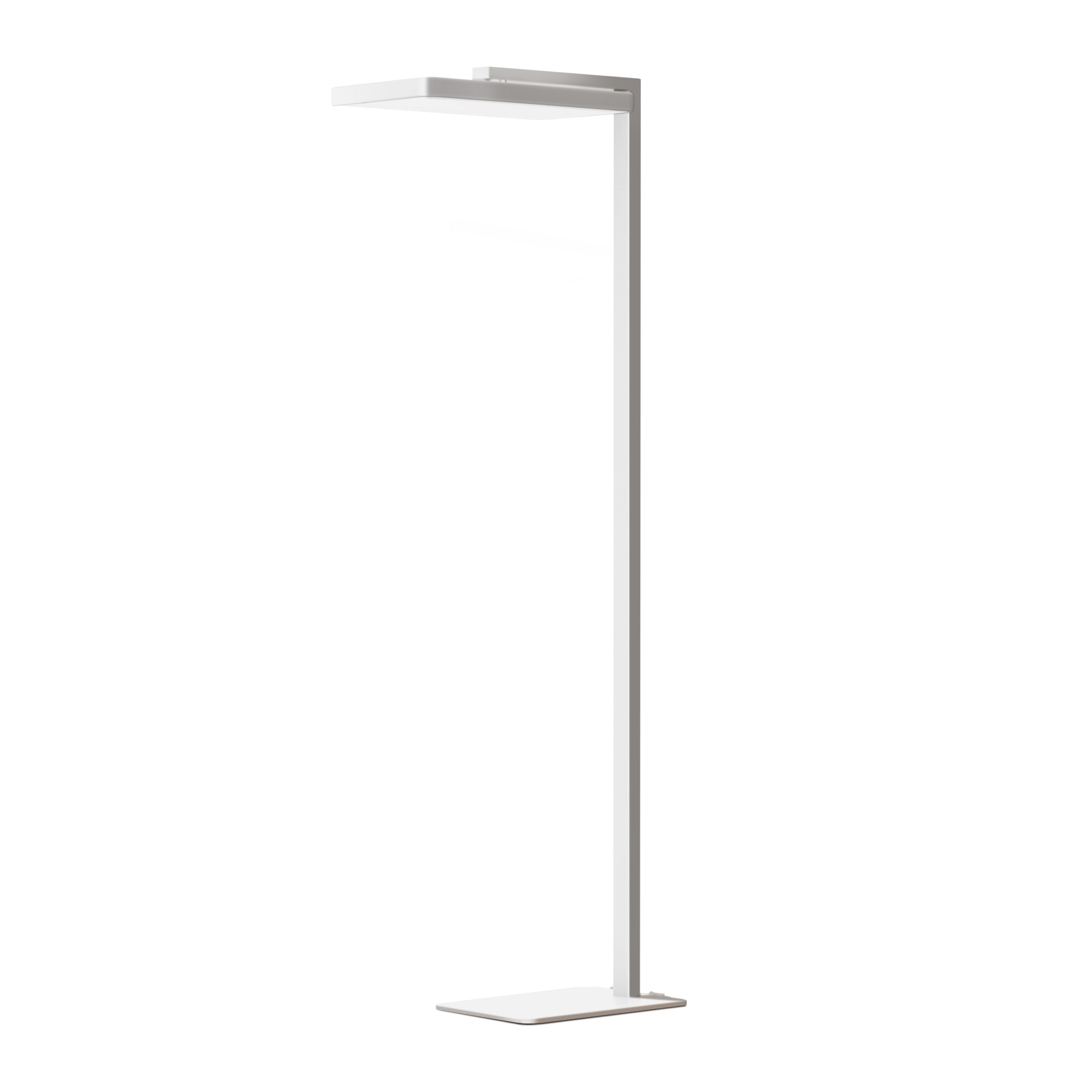
To eliminate these shadows, you need a supplementary task light that can be positioned below eye level. This is where the Lumimuse Floor Task Lamp bridges the gap between general illumination and precision work.

Unlike fixed overhead tubes, the Lumimuse Floor Task Lamp features a 90° rotatable head and dual light surfaces. This allows you to direct high-CRI, full-spectrum light exactly where your T8s can't reach—inside the wheel well or directly onto your drafting table—without creating glare.
6. Frequently Asked Questions
Can I use T5 LED tubes in my existing T8 fixture?
No, not directly. The T5 tube is physically shorter (in some standards) and uses a miniature G5 base (5mm pin spacing), whereas the T8 uses a larger G13 base (13mm spacing). You would need a conversion kit, but it is often more cost-effective to install a new T5 fixture or stick with T8 LEDs.
Which is cheaper to operate long-term: T5 or T8 LEDs?
T8 LEDs generally have a lower upfront cost and consume less wattage (15W vs 25W for T5HO), making them cheaper to operate for general lighting. However, if you need high-intensity brightness, a single T5 can sometimes do the work of two T8s, balancing the cost.
Do I need to replace my tombstones when switching to LED?
If you are performing a Type B (Ballast Bypass) installation, it is highly recommended to replace old "shunted" tombstones with "non-shunted" ones to prevent electrical shorts, especially if your new LED tubes are single-ended power.
7. Conclusion: The Final Verdict
For most residential garages with standard ceiling heights, the T8 LED (Type B retrofit) remains the champion of value and ease. It provides ample, even lighting that transforms a dark cave into a functional workspace.
However, if you are outfitting a professional shop with high ceilings, the T5 LED offers the intensity you need. Regardless of which tube you choose, remember that overhead light cannot bend around corners.
Ready to eliminate shadows forever? Complete your garage lighting ecosystem with the Lumimuse Floor Task Lamp, the ultimate tool for precision work that overhead tubes simply can't handle.
Further Reading: What You Need to Know About LED Tube Lights | Exploring LED Tube Advantages