Choose LED tube lights by their exact electrical compatibility as well as their physical fit. A matching tube shape does not establish that the existing ballast or supply arrangement is suitable. This UK selection guide gives you a record to take to the supplier or electrician before a replacement is chosen.
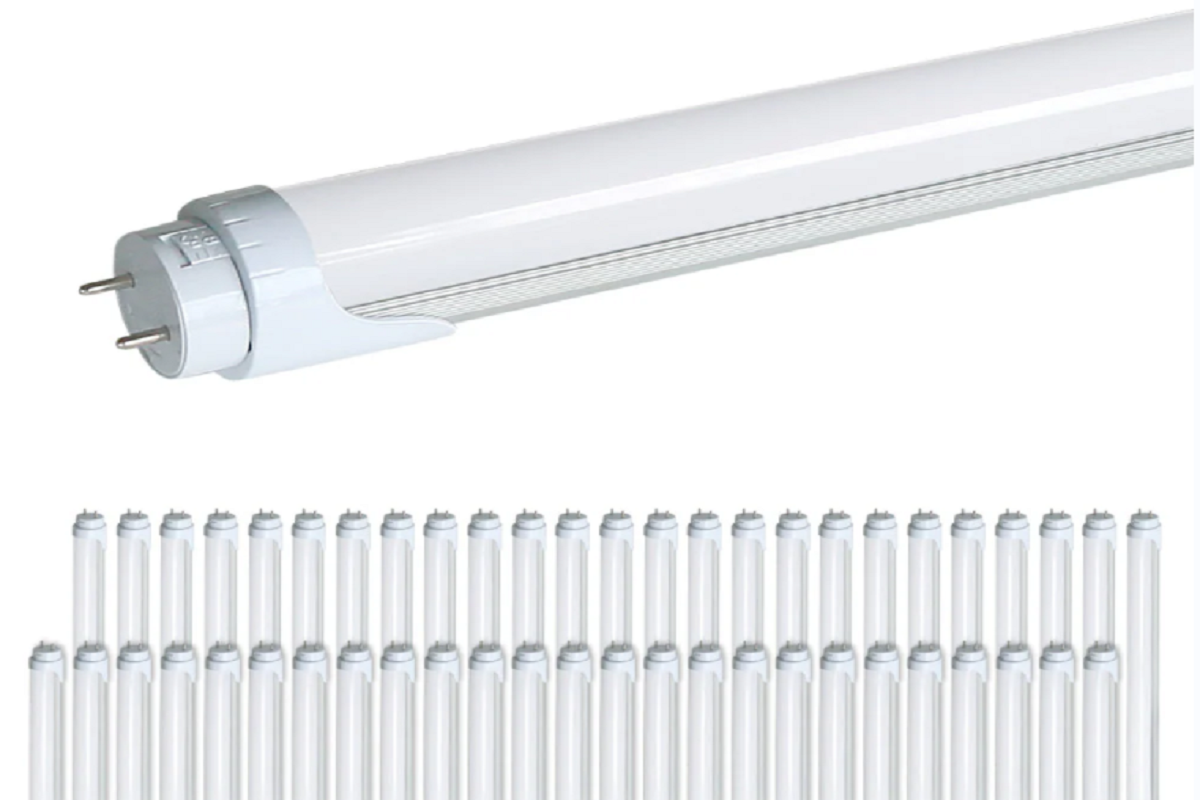
Image note: the cover is a generic tube-light montage. It does not identify the Philips example below, a pack quantity or a tested compatible fitting.
Start with a replacement record
Collect the existing tube code and the fitting documentation that is safely accessible. Ask an electrician to identify anything that requires opening fixed equipment. “T8” or a length description by itself is not a complete replacement specification.
| Record | Ask for this information | Why it matters |
|---|---|---|
| Existing fitting | Manufacturer, model and conversion history | Establish whether it has already been modified |
| Tube | Full reference and required physical size | Identify the exact proposed lamp |
| Control gear | Ballast model/reference and lamps per ballast | Find the right matrix row and conditions |
| Supply arrangement | Manufacturer-approved operating route | Avoid transferring instructions from another tube |
| Required function | Ordinary, dimmed or emergency operation | Check that the specific application is covered |
How to read a compatibility list
Philips’ UK installer hub links to a LEDtube ballast list. In the Q2 2025 document, the 600 mm MASTER LEDtube HF T8 table separates the exact tube references in columns from ballast model/reference and lamps-on-ballast count in rows. Its notes say these are laboratory recommendations and results can differ in an installation. Unlisted gear or a successor model is not automatically covered.
Concrete example: physical page 32 identifies 600 mm HO 8W 8xx T8 references 9290013931C, 9290013932C and 9290013933C. Its notes describe HF AC operation, do not guarantee DC operation, and do not develop those lamps for dimming. The page marks direct mains and electromagnetic ballast as incompatible for this example. Do not transfer that result to a differently coded LED tube.
Use the current Philips UK installer hub to check for updates; the Q2 2025 table and notes on page 32 illustrate the identification process. This guide does not certify any shop-supplied tube or ballast pairing.
A conversion changes the decision
Philips’ separate rewiring checklist calls for checks on the luminaire’s intended use, condition and protection class. It then requires the fitting to be labelled after the conversion it describes and says not to operate it with fluorescent lamps afterwards. That is a different scope from choosing a lamp for an unchanged fitting.
Ask the installer for the exact approved conversion instructions and a record of what was changed. This guide supplies no wire routing, ballast-bypass steps or generic supply-voltage recipe. The manufacturer conversion checklist is evidence of the checks involved, not permission to modify an arbitrary fitting.
Compare the light after compatibility is established
Lumens describe visible light output, while watts describe input power. CCT in kelvin describes colour appearance; it is not the lamp’s surface temperature. Compare the exact product data for these separate quantities rather than treating a cooler-looking lamp as inherently brighter.
Use the power and energy worksheet for running-cost estimates. If total installation savings matter, ask for input consumption of the complete arrangement. This guide provides no universal lifetime, saving percentage or warranty period.
LED tube replacement questions
Will any T8 LED tube fit my fluorescent light?
Matching the physical form is not enough. Check the exact LED tube reference, supply arrangement, ballast model and the manufacturer compatibility instructions for that combination.
Are all LED tubes dimmable?
No universal dimming claim is supported here. For example, the three 600 mm MASTER LEDtube HF T8 references discussed in the cited Q2 2025 document are not developed for dimming. Check your exact tube and control documents.
Can a converted fitting take a fluorescent tube again?
Do not assume it can. Philips’ cited conversion checklist says that after the conversion it describes, the fitting must not operate with fluorescent lamps and must carry the warning label. Follow the exact conversion record and instructions.
Your decision before purchase
Proceed with selection once the exact lamp, fitting, supply route and required function are documented as suitable together. If a code or conversion history is missing, resolve it with the supplier or electrician first. Emergency, controlled or specialist applications need their own appropriate instructions; an ordinary replacement example does not cover them.