Choose an LED outdoor flood light by matching documented output and controls to a specific site brief, then estimating the cost of the intended operating pattern. Start with what you need to see and when, rather than a brand ranking or a fixed lumen band for every garden. A product list cannot establish the result of an unassessed installation.
Separate light output from electrical input
Lumens describe total visible light output; watts describe electrical input power. Colour temperature describes colour appearance in kelvin, not the amount of light reaching your path or a guaranteed effect on alertness. These distinctions follow the US Department of Energy's terminology guide; its US purchasing requirements are not transferred to the UK.
Request the exact floodlight's lumen value, input power and distribution information, then ask how the proposed position serves the intended task. Do not infer useful coverage from watts alone.
Give the supplier or installer a site brief
| Question | Record from your site | Evidence to request |
|---|---|---|
| What needs light? | Entrance, work area or route, with a sketch | Distribution information for the proposed position |
| What is being compared? | Exact model and complete fitting | Documented lumens and electrical input |
| When should it operate? | Manual, scheduled or motion-triggered use | Exact supported controls and mode behaviour |
| Where may light spill? | Neighbouring windows, approach views and boundaries | Aiming and positioning plan for review |
| What will be exposed? | Fitting, cable entry, supply and accessories | Permitted location and installation instructions |
Review the proposed aiming from the approach and nearby viewpoints. Ask for changes if the light source is distracting or light lands outside the intended area. This is a design question to resolve before accepting the installation, not a promise of crime prevention or a statement of legal compliance.
Compare figures without inventing coverage
Hypothetical example: candidate A lists 2,400 lm at 30 W and candidate B lists 2,200 lm at 20 W. The arithmetic is 80 lm/W and 110 lm/W respectively. B has the higher ratio in this example, while A lists more total lumens. Neither calculation establishes which produces the better result at your gate; check the exact model information and proposed arrangement.
Estimate cost from the hours you expect to use
For a constant-power estimate, energy in kWh equals watts multiplied by operating hours, divided by 1,000. Cost equals kWh multiplied by the unit rate. The National Energy Action electricity guide, physical page 2, explains the units and calculation; use your bill for the actual rate, not the leaflet's historical prices.
Hypothetical example: 20 W for 3 hours a day over 30 days is 20 × 3 × 30 ÷ 1,000 = 1.8 kWh. At an illustrative 30p/kWh that is 54p. This excludes standby and different power levels, assumes those hours actually occur, and is not a current tariff or a measured product saving.
Check the complete installation boundary
IP65 describes dust-tight and water-jet protection, not all weather stresses or the life of a fitting. Read the exact location and mounting instructions for the fitting and its accessories. Do not treat a brand name, an IP number, or a US label as proof that an arbitrary UK installation is suitable.
Electrical Safety First recommends RCD protection and outdoor-suitable leads and connectors. Ask a qualified electrician to assess fixed wiring, supply and installation questions; this guide does not give wiring or live-testing steps.
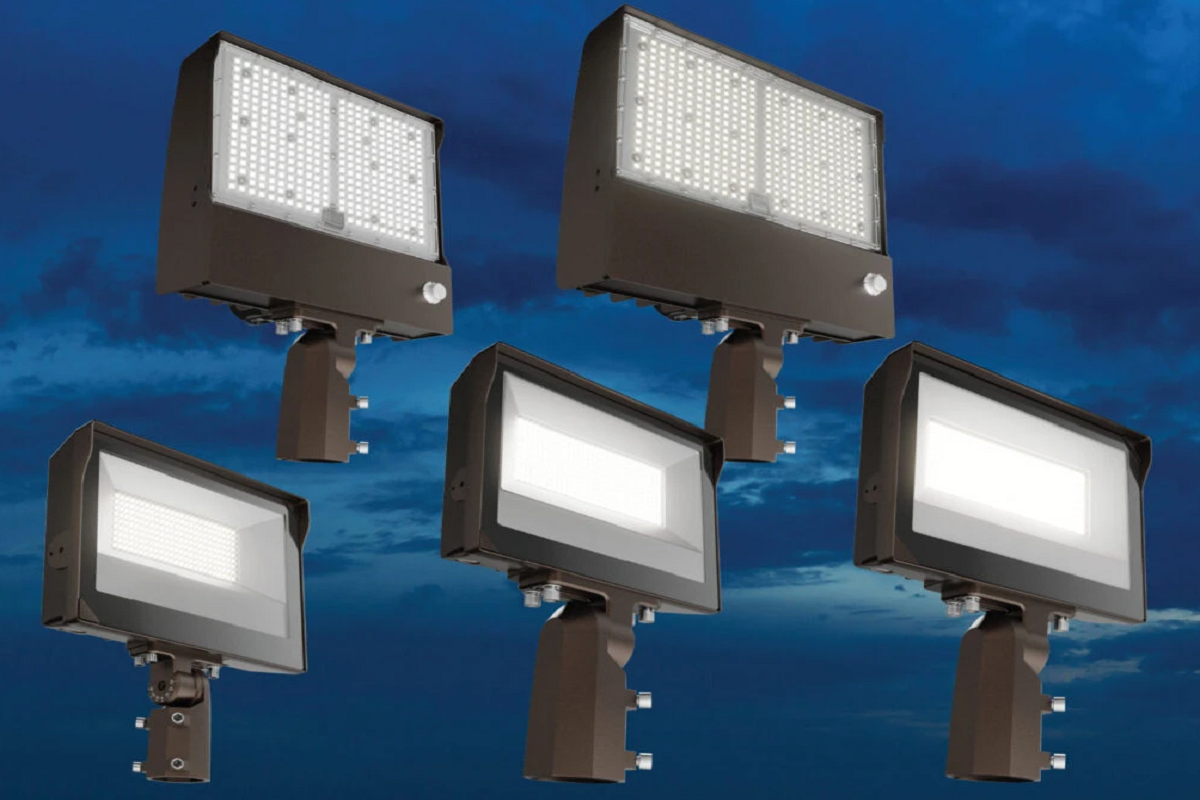
Image note: the floodlight composite illustrates housing shapes. It is not a measured beam comparison, product ranking or proof of output, outdoor suitability or supplied accessories.
Keep the comparison checkable
Retain model codes, the proposed control mode and the cost assumptions with your site brief. See the LED wattage and cost guide for unit calculations and IP rating boundaries for the distinction between protection tests and a complete application.
Frequently asked questions
How many lumens does an outdoor flood light need?
This guide does not set a universal lumen target. Record the area and task, ask for the exact product's distribution information and assess the proposed installation rather than assuming a wattage or garden-size band is enough.
Is a 20 W floodlight always brighter than a 10 W one?
Watts describe electrical input power, while lumens describe visible light output. Compare the exact documented lumen values and intended arrangement; wattage alone does not establish brightness or useful coverage.
How do I estimate a floodlight's running cost?
For a constant-power estimate, divide watts multiplied by operating hours by 1,000 to obtain kWh, then multiply by your actual unit rate. Allow separately for other operating modes or standby use; a hypothetical example is not a current tariff.