Good outdoor strip lighting ideas begin with a clear job for each area: outline a seating space, draw attention to a feature or add a decorative line along a boundary. Choose a few connected zones rather than outlining everything. The ten concepts below are design suggestions; confirm the exact kit, component locations and mounting instructions before fitting.
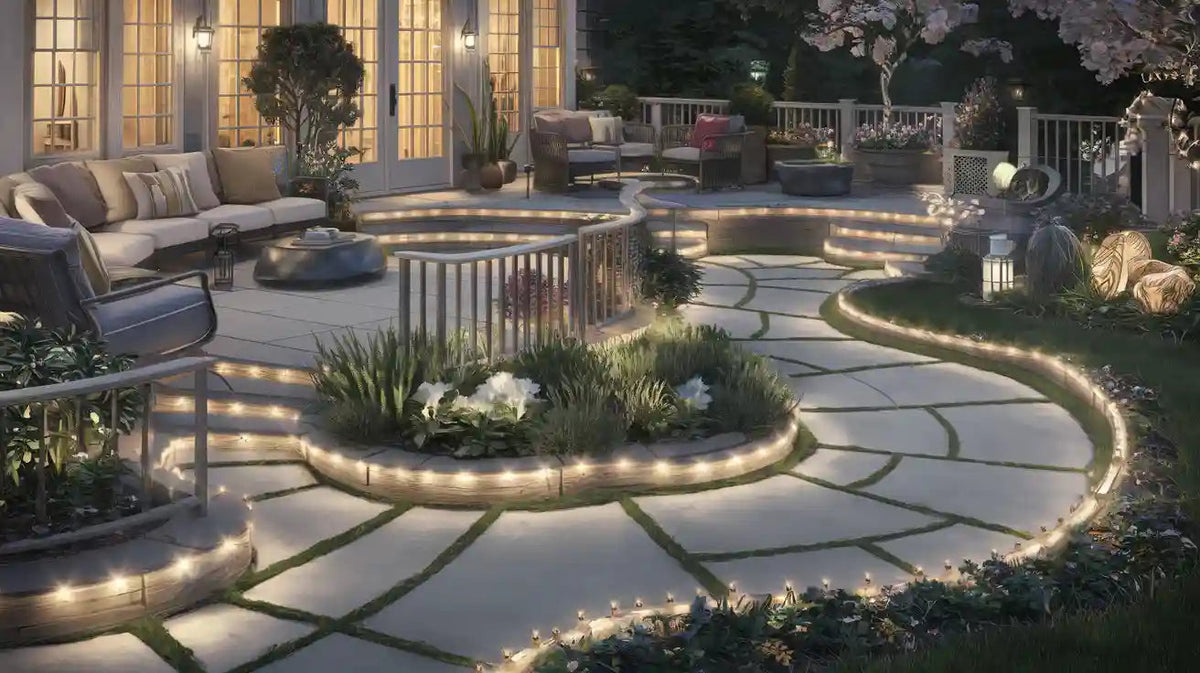
Cover image: a garden-lighting illustration, not a completed installation, a brightness measurement or proof of outdoor suitability.
Ten ideas to adapt to your space
- Frame one patio edge. Sketch a single continuous line beside the seating area. Decide which side should draw attention, and keep the supply location on the same drawing.
- Outline a pergola. Use the structure as a visual frame. Before choosing a kit, measure each change of direction and check the permitted bends and mounting method.
- Add an under-bench accent. Consider a concealed line beneath a fixed bench. Check whether the proposed position allows access to the fittings and connections for inspection.
- Highlight a planter boundary. Draw the line on the outside of the feature rather than assuming a strip can be buried in soil. Ask the supplier about the exact proposed position.
- Trace a fence section. Pick a short focal section instead of every panel. Note gates, moving parts and places where the route may need to stop.
- Give a wall a decorative edge. Compare a horizontal outline with a short vertical accent on your sketch. View the proposed location from both the seating area and nearby windows.
- Accent a level change. A line beside a step can be a design feature, but do not treat decorative strip lighting as proof of adequate route illumination. Assess the walking route separately.
- Define a dining zone. Separate the decorative outline from the lighting needed to see the table and serving area. Choose the strip after deciding which task it is intended to perform.
- Create a removable party layout. Plan where equipment will go and how it will be put away. Keep temporary arrangements subject to the same component and cable checks as a fixed design.
- Make one feature the focus. Draw attention to a sculpture, screen or raised border with a nearby accent. Water features, fire pits and cooking areas need a separate suitability assessment; do not copy a photograph as an installation plan.
Turn an idea into a zone plan
Try this simple example: zone A is the seating border, zone B is a pergola and zone C is a decorative planter edge. Measure them separately; do not assume that one long strip or one power supply can serve all three. This is a planning exercise, not a wiring design.
| Zone | Record before selecting a kit | Your notes |
|---|---|---|
| A: seating border | Route, corners and nearby component locations | _____ m; _____ |
| B: pergola | Mounting surface, height and access | _____ |
| C: planter edge | Exposure, maintenance access and stopping points | _____ |
| Each zone | Exact kit, manual, permitted length and outstanding questions | _____ |
Keep the sketch and questions together. If the manual does not support the proposed position or length, change the plan before buying mounting parts.
Check the product rules behind the picture
Cutting is model-specific. For example, the UK manufacturer page for Hue Lightstrip Outdoor 5 metre, 8718699709938, lists no cutting or strip extension. That is one documented example, not a rule for every strip.
Electrical Safety First's garden guidance recommends RCD protection, suitable outdoor connections and checks for damaged cables. Use our installation planning checklist for the next stage; have an electrician assess uncertain supplies or fixed-wiring changes.
Planning questions
How many lighting zones should I start with?
Choose one focal area first, then add another only if it serves a distinct purpose. Use the worksheet to keep each route and its unanswered questions visible.
Can I cut a strip to follow a curved border?
Check its exact cutting and bending rules first. The cited Hue model cannot be cut or extended as a strip; a similar-looking product may have different rules.
Where do I compare suitable kits?
Use our outdoor LED strip buying checklist. It separates documented features from missing answers and avoids treating an illustrative garden scene as evidence.
Editorial update: 18 October 2026. Sources are linked at the relevant passages. This is a document-based guide; no first-hand product testing is claimed.