Choose a motion sensor light by separating three questions: where you want movement detected, what you need to see, and how you want the light to behave. Compare the exact model's instructions with your approach route before relying on a headline range.
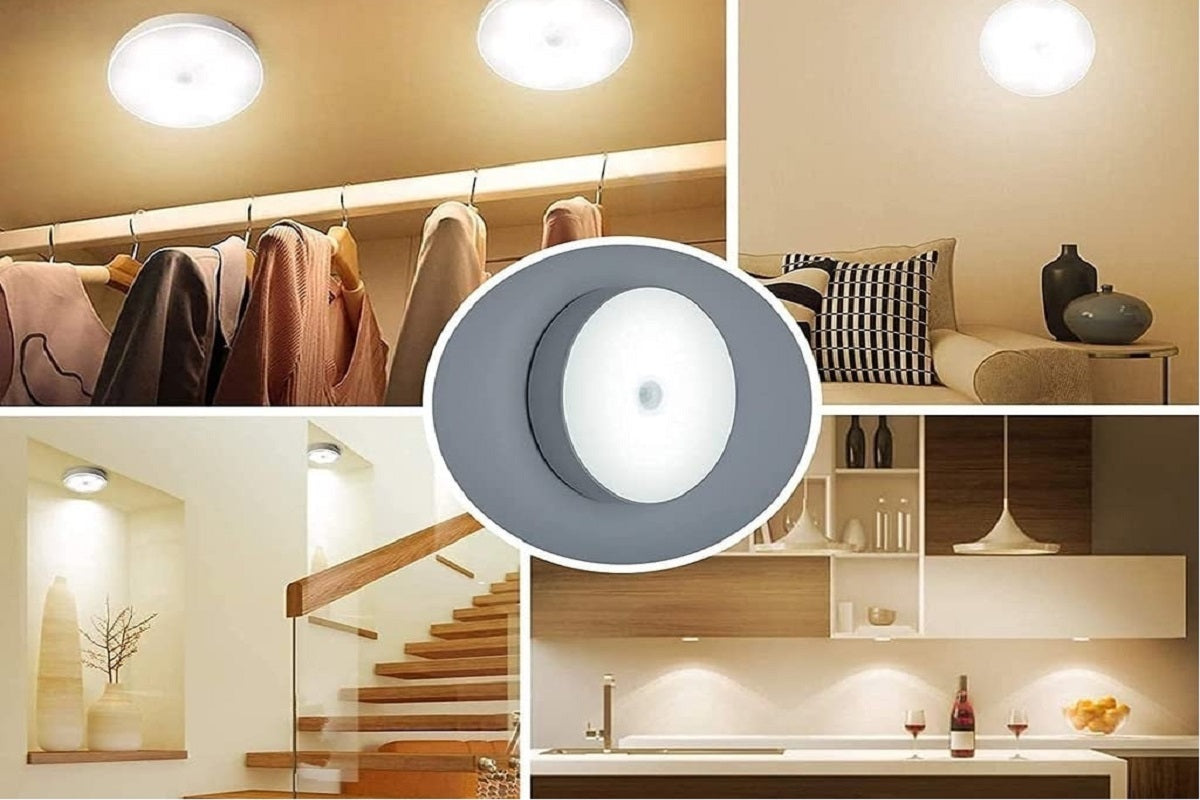
Cover image: a composite of round lights in several rooms. It does not verify sensor technology, detection coverage, brightness or suitability for any depicted location.
Describe the route before comparing metres
Suggested starting point: sketch the door, path, turn and place where you need light. Mark neighbouring windows, passing traffic and vegetation as things to consider. Record the existing light and possible fitting positions without treating a sketch as an installation design.
Keep two questions on separate lines: “Does the sensor notice the intended approach?” and “Can I see the intended area when the light operates?” A detection-distance number alone is insufficient evidence to answer both.
Keep the conditions beside the range
For a specific documentary example, the Steinel XSolar L-S manual, covering white EAN 4007841671006 and silver EAN 4007841671013, states a maximum infrared detection reach of 8m at a mounting height of 1.8m on printed page 10. This is conditional manufacturer information, not our measurement, a guaranteed circle of coverage or a universal mounting instruction.
Use an approach-route observation sheet
Suggested worksheet for a safely installed light, or questions to take to the supplier or installer. Use the actual time and conditions; do not label a proposed setup as tested.
| Question | What to record | What to compare |
|---|---|---|
| Intended approach | Route, direction and where activation begins | Exact model's detection and siting guidance |
| Visibility after activation | The door, turn or area you need to see | The lighting task, separately from detection |
| Unwanted activation | Time, weather and nearby movement | Model-specific troubleshooting, not a guess |
| Operating mode | Chosen setting and observed behaviour | The manual's available modes and limits |
Hypothetical example: a light activates for a person on the pavement but misses the route from the gate. Record both observations and discuss the intended detection zone with the installer. Do not assume that maximum sensitivity is the answer or make wiring changes to investigate.
Check the mode and possible trigger causes
The same XSolar L-S manual distinguishes P1 sensor mode from P2 with additional basic lighting. It notes that basic lighting reduces light availability and that brightness and stay-on behaviour can adapt to ambient conditions. “Sensor light” therefore does not establish one universal off-between-detections behaviour.
Printed page 12 lists possible unwanted-trigger causes for those models, including moving trees or bushes, passing cars, abrupt temperature changes and the fitting moving in wind. These are troubleshooting possibilities for that model, not a diagnosis for another sensor or your installation.
Resolve the power and outdoor-use questions
Before buying, ask who will provide a suitable mains connection, or where the exact battery or solar model may be used and maintained. Check the whole fitting and connections against the manufacturer's instructions; do not infer year-round operation, all-weather durability or automatic home-security integration from the product category.
Electrical Safety First’s garden guidance recommends RCD protection for outdoor electrical equipment, suitable outdoor connections and undamaged cables. Switch off and unplug plug-in equipment before checks or adjustment. This is safety guidance, not a certificate for a product or site.
Use a qualified electrician for fixed-wiring questions; do not attempt to restore weather protection by sealing exposed wiring yourself. For the separate solar-panel question, see our solar light siting guide. For light output and running-cost comparisons, see the outdoor flood-light comparison guide.
Questions before choosing
What is the best mounting height for a motion sensor light?
Use the exact model's instructions. The XSolar L-S manual's maximum 8m reach is stated at a mounting height of 1.8m; it is not a universal height or a guarantee of coverage at your home.
Why might a light come on when nobody is approaching?
For the named XSolar L-S models, the manual lists possible causes including moving vegetation, passing cars, abrupt temperature changes and the fitting moving in wind. These are model-specific possibilities, not a diagnosis of an unidentified light.
Will every motion sensor light stay completely off between detections?
No such general rule is established here. The XSolar L-S manual distinguishes P1 sensor mode from P2 with additional basic lighting, and notes that basic lighting reduces availability. Check the operating modes of the exact model you are considering.