
I. Introduction
You are bidding on a 25,000 sq. ft. warehouse retrofit. The client wants "bright lights" and a lower energy bill. You have two choices: the round UFO High Bay or the rectangular Linear High Bay.
Choosing the wrong fixture shape here isn't just an aesthetic error—it creates "photometric waste." If you install round beams in narrow aisles, you waste lumens on the tops of racking and leave shelf labels in shadow. If you install linear fixtures in a wide-open gymnasium, you increase your labor hours with complex alignment requirements.
This guide moves beyond generic comparisons. We analyze the physics of beam spread, installation labor economics, and application geometry to help you specify the right fixture for the job and understand the nuances of UFO vs Linear High Bay selection.
Quick Answer: UFO vs. Linear High Bays
- UFO High Bays (Round): Best for open floor plans (gyms, manufacturing floors). They emit a conical 120° beam, offering the fastest "single-point" installation.
- Linear High Bays (Rectangular): Best for aisles and high-racking. They emit a rectangular beam (e.g., 100° x 40°) that aligns with shelf geometry, maximizing vertical foot-candles on product labels.
II. The Impact of Beam Angle & Light Distribution (Photometrics)
Light creates a footprint. To rank #1 in efficiency, you must match the fixture's footprint to the room's floor plan.

Circular vs. Rectangular Spread
- UFO High Bays: These utilize a circular lens layout, typically projecting a 120° conical beam. In an open grid (e.g., a 100x100 open warehouse), these circles overlap to create uniform coverage.
- Linear High Bays: These arrange LED diodes in strips, naturally creating a rectangular throw.
The "Photometric Waste" Concept
In a warehouse aisle, the goal is Vertical Illuminance—lighting the face of the boxes on the shelf, not just the floor.
If you place a round UFO fixture in a 10-foot wide aisle:
- Wasted Energy: A significant percentage of the 120° cone hits the top of the racking shelves. This light never reaches the floor or the product face.
- The "Swiss Cheese" Effect: Because the beam is round, the gap between fixtures becomes a dark spot. To fix this, you must install fixtures closer together, increasing your fixture count and material cost.
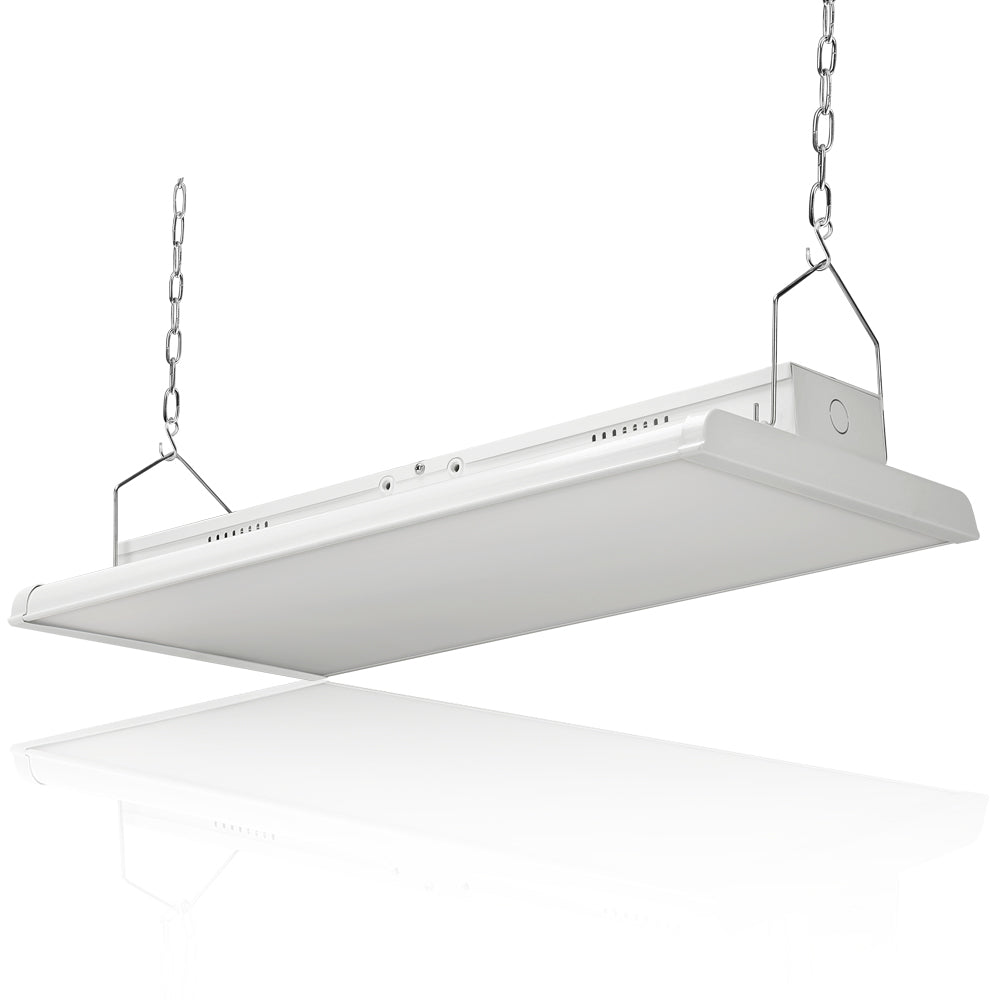
Linear Advantage: A fixture like the Linear LED Bay Ceiling Light (105W) directs light in a longitudinal pattern. It acts like a "highway" of light, pushing lumens down the length of the aisle and washing the vertical rack faces with light.
III. Application Scenarios: Where Each Fixture Wins
Use this matrix to determine the correct specification based on facility geometry when considering LED High Bay Lighting for Commercial spaces.
| Application Environment | Recommended Fixture | The "Why" (Entity Relationship) |
|---|---|---|
| Warehouse Aisles | Linear High Bay | Beam Conformity. Rectangular beams match the aisle shape. Maximizes vertical foot-candles on inventory labels. |
| Open Manufacturing Floor | UFO High Bay | Uniformity. Overlapping circular beams eliminate shadows in open grids. Easier to clean in dusty environments. |
| Gymnasiums / Sports Halls | UFO High Bay | Impact Rating. Round fixtures often have robust die-cast housings and wire guards (IK10 ratings) suited for ball strikes. |
| Big Box Retail / Grocery | Linear High Bay | Aesthetics & Alignment. Creates clean, continuous lines of light that guide the customer's eye down the shopping aisle. |
| Automotive Workshops | Linear High Bay | Shadow Reduction. Long light sources reduce hard shadows under vehicle hoods compared to point-source UFOs. |

Scenario A: The High-Rack Warehouse (Linear Wins)
In facilities with 20+ foot racking, Linear High Bays are the mathematical choice. By aligning the fixture with the aisle, you reduce the fixture count required to hit target light levels (e.g., 30 fc). The rectangular form factor minimizes glare for forklift operators looking up at high shelves.
Scenario B: The Open Convention Center (UFO Wins)
For clear heights of 25+ feet in open spaces, UFO High Bays offer superior lumen-per-dollar value. Their radial heat dissipation is highly efficient, and the single-point hanging method drastically cuts installation time on high lifts.
IV. Installation Labor & Mounting Interfaces (The Bottom Line)
For a contractor, the cost of the fixture is only half the equation. Labor hours determine the profit margin.
📺 Related Video: UFO vs Linear High Bay installation comparison
Single-Point vs. Dual-Point Mounting
- UFO Speed Advantage: UFOs use a standard Eye-Hook (M10/M12). You hang it, tighten the set screw, and wire it. It is a true "one-hand" hang.
-
Linear Stability Requirements: Linear fixtures usually require V-Hooks and Chains (dual-point mounting). While stable, this takes roughly 2x longer to level and align than a UFO.
- Bid Tip: If using Linears, laser alignment is crucial. A crooked linear fixture in a long hallway is visually obvious and unprofessional.
Retrofit Logic
- Replacing Metal Halide (400W HID): Use UFOs. The round footprint covers the old round stain on the ceiling, and the wiring location is identical.
- Replacing T5/T8 Fluorescent Tubes: Use Linears. The 2ft or 4ft form factor covers the old footprint and utilizes the existing spacing grid, preventing the need to re-pipe conduit.
Smart Controls Integration
Modern energy codes (IECC/ASHRAE) often require motion sensors.
- UFOs: Sensors typically screw into the center face (easy access).
- Linears: Sensors attach to the end-cap.
- Product Note: The Lumimuse 105W Linear features a "plug-and-play" sensor port, allowing contractors to install sensors in seconds without opening the driver box.
V. Durability & Component Lifespan (Thermodynamics)
Heat is the enemy of LED longevity. The shape of the fixture dictates how it manages Thermal Junction Temperature.

Heat Dissipation
- UFOs: The radial fin design is thermodynamically superior for passive cooling. Air flows through the fins from all directions. This makes UFOs the preferred choice for high-heat industrial forges or unconditioned spaces.
-
Linears: These rely on an extruded aluminum backing. While effective, they have more surface area prone to dust accumulation.
- Maintenance Insight: In environments with heavy airborne debris (woodshops, textile mills), UFOs are easier to blow down with compressed air.
Lens Material
- Polycarbonate (PC): Used in the Lumimuse Linear 105W. It is impact-resistant and creates a diffused, glare-free light (crucial for low-bay applications <15ft).
- Acrylic (PMMA): Often an option for Linears. It does not yellow under UV exposure but is brittle.
VI. Conclusion
The debate between UFO vs Linear High Bay is not about which technology is "newer"—it is about Geometry and Labor.
- Specify Linear High Bays when you have aisles, racking, or rectangular workbenches. The rectangular beam maximizes usable light and reduces the number of fixtures needed to eliminate shadows.
- Specify UFO High Bays when you have open grids or need to minimize installation labor on high ceilings.
Contractor Takeaway:
If you are retrofitting a warehouse with aisles, the Linear LED Bay Ceiling Light - 105W is your profit-maximizing tool. It delivers 14,700 lumens specifically where the client needs them—on the product—eliminating the waste of circular beams in rectangular spaces.
Need a Photometric Layout?
Don't guess on foot-candle levels. Upload your floor plan to Lumimuse for a free simulation to guarantee you meet OSHA lighting standards before you order.