
Decoding Acuity (Lithonia) vs. Signify (Cooper) performance, control ecosystems, and the best ROI for industrial facilities.
The Stakes of Industrial Lighting
For a warehouse manager, a lighting failure isn't just a maintenance ticket—it is a safety hazard and a productivity killer. When evaluating High Bay LED Lighting for industrial applications, the decision often narrows down to two titans: Lithonia Lighting and Cooper Lighting. However, the choice is rarely just about the fixture itself; it is about the ecosystem you adopt.
What is the difference between Lithonia and Cooper High Bays?
Lithonia vs. Cooper Lighting: While both brands dominate the industrial sector, Lithonia (Acuity Brands) is generally preferred for its high-output versatility and industry-standard nLight controls, making it ideal for large-scale logistics hubs. Cooper Lighting (Signify) often leads in energy efficacy (lumens per watt) and sophisticated wireless mesh networking via WaveLinx, making it the top choice for smart-warehousing and LEED-certified facilities.
This comparison evaluates luminous efficacy, thermal durability, and the critical concept of "Control Ecosystem Lock-in" to determine the best Return on Investment (ROI) for your floor plan.
The Parent Brands: Acuity Brands (Lithonia) vs. Signify (Cooper)
Lithonia Lighting is the flagship industrial brand of Acuity Brands, a North American market leader known for its "I-BEAM" legacy. Their fixtures are ubiquitous in distribution centers due to their rugged reliability and the massive installer network familiar with their hardware.
Cooper Lighting Solutions, now part of Signify (formerly Philips Lighting), brings a heritage of engineering excellence, often leveraging technologies from their Crouse-Hinds lineage which specializes in harsh environments. Cooper focuses heavily on the integration of IoT (Internet of Things) within their fixtures.
| Feature | Lithonia (Acuity) | Cooper (Signify) |
|---|---|---|
| Parent Company | Acuity Brands | Signify |
| Primary Control System | nLight (Wired/Air) | WaveLinx |
| Flagship Series | IBG / I-BEAM | Steeler / Corelite |
Performance Attributes: Efficacy, Optics, and Lifespan
Luminous Efficacy is the measure of how well a light source produces visible light, expressed in lumens per watt (lm/W). In the high bay sector, efficacy determines your electrical bill.
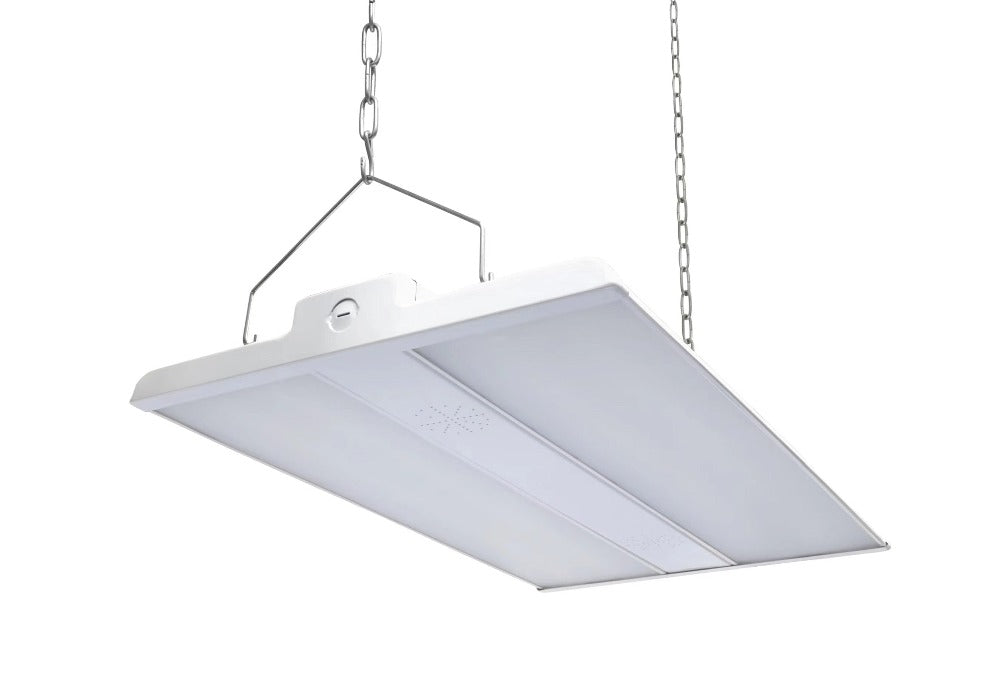
Both Lithonia's IBG and Cooper's IBH series push the limits of LED technology. However, alternatives like the Linear LED High Bay Light (225W) utilize advanced LED chips to achieve 31,500 lumens at 5000K, offering a highly competitive efficacy profile that rivals the major brands without the proprietary markup.
Thermal Management and Heat Dissipation
The Heat Sink (Entity) is a passive heat exchanger (Attribute) that transfers heat generated by the LED driver away from the junction point (Function). Efficient thermal management is critical because heat is the primary cause of premature driver failure in warehouse environments.

When selecting fixtures, prioritize the L70 Rating. This metric indicates the number of hours before the light output degrades to 70% of its original brightness. High-quality fixtures typically offer L70 ratings exceeding 100,000 hours.
For a deeper dive into form factors, read our guide on the Advantages of LED UFO High Bay Lights versus linear models.
The "Control Lock-In": nLight vs. WaveLinx
Lighting Control Systems are networked architectures that manage the input/output of light fixtures based on occupancy, daylight, and scheduling. This is where the real differentiation—and risk—lies.
nLight (Lithonia)
The nLight platform utilizes a distributed intelligence architecture. This means each fixture and sensor has a "brain," reducing the risk of a single point of failure. It is renowned for its scalability, easily moving from a single room (nLight Air) to a campus-wide network.
WaveLinx (Cooper)
WaveLinx is Cooper's wireless mesh network solution. It integrates deeply with the Trellix smart building platform. WaveLinx is excellent for gathering granular data on energy usage and space utilization, often preferred by facility managers who need detailed analytics for ESG reporting.
The Warning: If your facility's Building Management System (BMS) is optimized for one protocol, switching brands for the warehouse creates a "siloed" system. However, for many standalone warehouses, these complex systems are overkill. A fixture with standard 1-10V Dimming and a standalone motion sensor often provides 90% of the energy savings with 0% of the software subscription costs.
📺 Related Video: Linear LED High Bay Light - 225W - 1X4FT - 31500 Lumens - 5000K - 600W Equal installation and dimming setup
Total Cost of Ownership (TCO) & Installation
Total Cost of Ownership is the calculation of the initial fixture cost (CAPEX) plus the operational energy and maintenance costs (OPEX) over the fixture's life. While Lithonia and Cooper offer premium reliability, their initial price points reflect their brand equity.

Installation Versatility
Time is money during installation. The Linear LED High Bay discussed here features a compact design compatible with:
- V-Hooks & Chains: Standard suspension for open ceilings.
- Surface Mount Adapters: For low-clearance areas.
- Pendant Mounts: Rigid conduit mounting for fixed positioning.
Rebate Eligibility
Always verify DLC Premium Certification. Utility companies offer substantial rebates for fixtures that meet DesignLights Consortium standards. This can offset up to 40% of the initial hardware cost. Learn more about ROI in our article on Pros and Cons of LED High Bay Lighting.
| Spec | Avg. Big Brand High Bay | Konlite Linear LED High Bay |
|---|---|---|
| Wattage | 200W - 240W | 225W |
| Lumens | 28,000 - 30,000 | 31,500 (High Efficacy) |
| Dimming | Proprietary / 0-10V | Universal 1-10V |
| Input Voltage | 120-277V | 120-277V |
Conclusion: Which Light Fits Your Warehouse?
The battle between Lithonia vs. Cooper Lighting comes down to your facility's digital strategy. Choose Lithonia if you need a widely supported, contractor-friendly workhorse with the nLight ecosystem. Choose Cooper if your priority is granular data analytics and integration with the Signify IoT platform.
However, for facility managers seeking a high-performance, cost-effective replacement for 400-600W HID fixtures without the complexity of proprietary software, the Linear LED High Bay Light (225W) offers superior luminous efficacy (31,500 lumens) and universally compatible 1-10V dimming. It bridges the gap between premium performance and practical affordability.