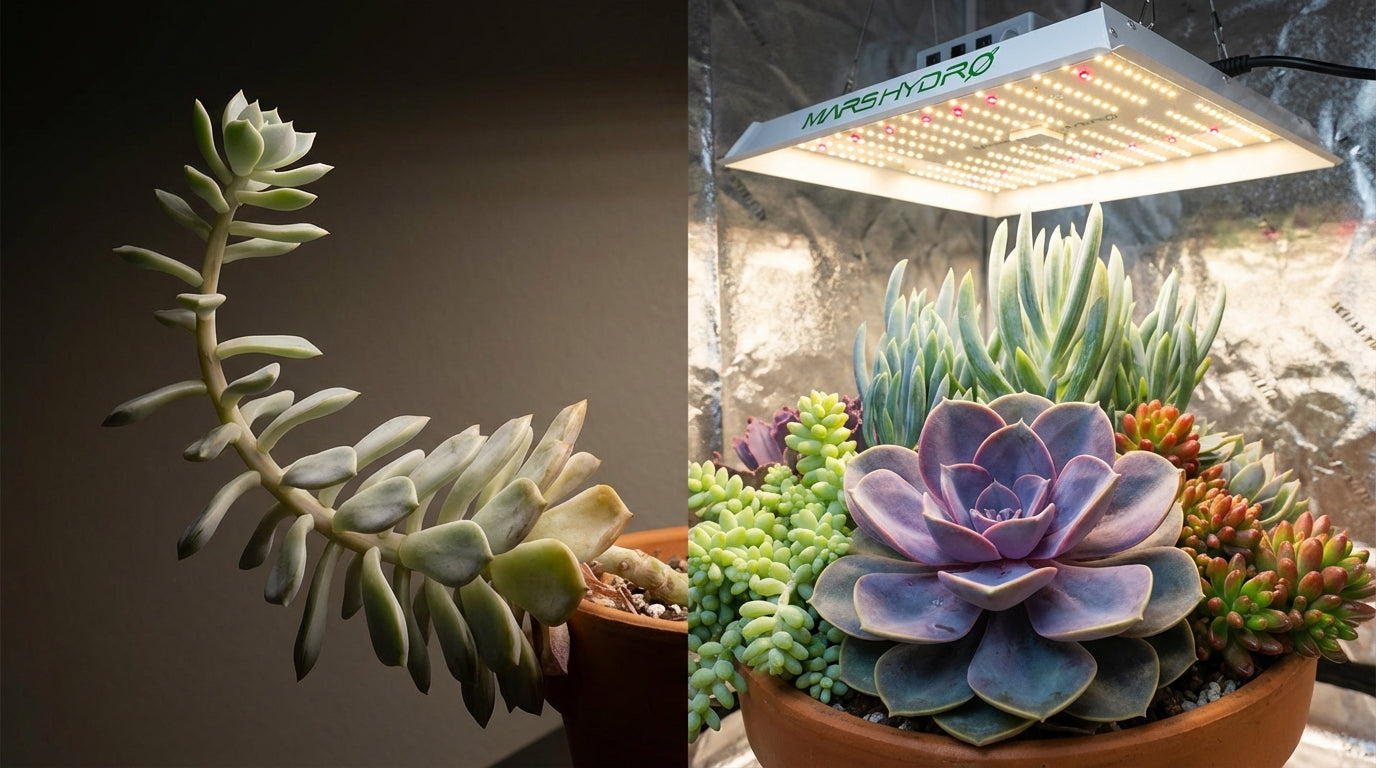
Your Echeveria isn’t "reaching for the stars"—it’s starving.
If your compact desert plants are slowly morphing into spindly, pale alien towers, you are witnessing etiolation—a desperate biological response to low light. For succulent hobbyists, the solution often comes down to two market titans: GE Lighting (the household name) and Sansi (the ceramic tech pioneer).
But in 2026, the debate isn't just about "brightness." It's about PPFD (photosynthetic power), heat management, and whether your living room looks like a cozy space or a purple-hued laboratory. When choosing LED Grow Lights for Indoor Plants, the specific light requirements of succulents change the game entirely.
The Short Answer
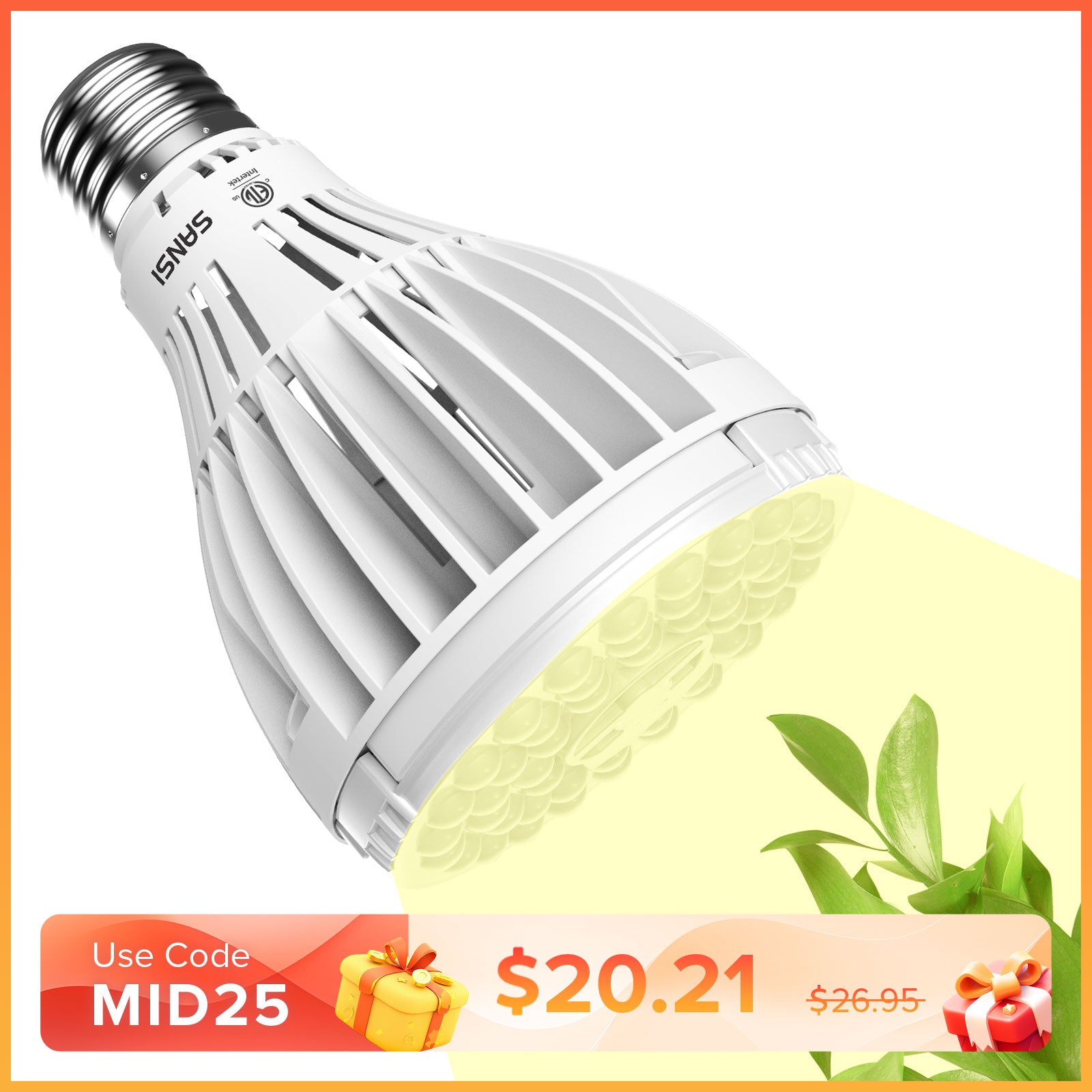
If you need to keep a high-light succulent collection (Echeveria, Sedum, Cactus) compact and colorful, the Ceramic LED (Sansi-style/Lumimuse PAR25) is the superior choice due to its massive 227.5 μmol/s intensity and focused optical lens.
However, for general houseplants or a "living room friendly" aesthetic where extreme intensity matters less than visual comfort, the GE Seeds & Greens remains the reliable, low-heat generalist.
1. Why Succulents Demand "High-Intensity" Physics
Before we dissect the bulbs, we must kill the "Lumens" myth. Your human eyes perceive brightness in Lumens, but your succulents "eat" photons measured in Micromoles (μmol). Finding the right grow lights for succulents requires looking at the technical data, not just the visual glare.

Succulents have a high Daily Light Integral (DLI) requirement. To maintain those vibrant "stress colors" (pinks, purples, and deep reds) and tight rosette shapes, they typically require a PPFD (Photosynthetic Photon Flux Density) between 300 and 600 μmol/m²/s for at least 12 hours a day.
- Low Light (Haworthia, Gasteria): ~100-200 μmol/m²/s
- Medium Light (Crassula, Aloe): ~200-400 μmol/m²/s
- High Light (Echeveria, Sempervivum): ~400+ μmol/m²/s
If you use a weak light, your Echeveria will stretch to find more photons. This is why standard desk lamps fail and why we are comparing high-output LEDs.
2. Head-to-Head: GE Seeds & Greens vs. Ceramic LED (Sansi/Lumimuse)
We analyzed the GE Seeds & Greens (32W PAR38) against the High-Performance Ceramic PAR25 (24W) category. In our comparison of which LED plant grow light is best, specialized tech often outperforms mass-market brands.
Note: For the Ceramic category, we are using the 2026 benchmark specs from the PAR25 24W LED Grow Light Bulb, which utilizes the same patented Chip-on-Ceramic (COC) technology as Sansi but features an upgraded secondary optical lens.
| Feature | GE Seeds & Greens (32W) | Ceramic LED / Lumimuse (24W) | The Winner |
|---|---|---|---|
| Actual Wattage | 32 Watts | 24 Watts | Ceramic (Efficiency) |
| PPFD @ 12" (1ft) | ~50-100 μmol/m²/s (Flood) | 227.5 μmol/m²/s (Focused) | Ceramic (By far) |
| Spectrum | Balanced "Pinkish-White" | 4000K Full Spectrum Daylight | Ceramic (Visuals) |
| Tech Material | Aluminum/Plastic | Patented Ceramic (COC) | Ceramic (Heat) |
| Beam Angle | Wide Flood (~120°) | Focused Lens (~60°) | Ceramic (Intensity) |
| Lifespan | 25,000 Hours | 25,000 Hours | Tie |

Analysis: The "Intensity" Gap
The most shocking data point is the PPFD. The GE bulb is designed as a floodlight—it sprays light wide. This is great for a large tray of lettuce seedlings (low DLI), but for a succulent, it dilutes the intensity. The grow lights for succulents that work best are those that concentrate energy on the plant canopy.
The Ceramic PAR25 (specifically the Lumimuse model) uses a Secondary Optical Design—a specialized lens that focuses the photons directly downward. This achieves a staggering 227.5 μmol/s at one foot. For an Echeveria, this is the difference between staying compact and stretching out.
3. The "Ceramic Advantage": Why Material Matters
Why do high-end brands like Sansi and Lumimuse use ceramic bodies instead of the aluminum fins found on GE or cheap Amazon bulbs?
1. The Heat Problem
LEDs don't emit infrared heat like old incandescent bulbs, but the chips do get hot. If that heat isn't moved away, the LED burns out.
- Aluminum (GE/Generic): Uses a PCB (printed circuit board) glued to aluminum. It works, but the glue creates "thermal resistance."
- Patented COC (Chip on Ceramic): The LED chips are soldered directly onto the non-conductive ceramic body. There is no glue and no PCB. This reduces system thermal resistance, allowing the bulb to run harder and brighter without overheating.
2. Safety (The V0 Standard)
The Lumimuse/Sansi ceramic body is V0 Flame Retardant. In the unlikely event of a failure, ceramic doesn't catch fire. Plastic and cheap aluminum housings can melt. If you are running grow lights for succulents 12 hours a day while you're at work, this peace of mind is non-negotiable.
4. The "Living Room" Factor: Aesthetics & Color
In 2026, the trend is "Biophilic Design"—integrating plants into our workspaces and living rooms. You don't want a purple "blurple" grow light ruining your Zoom background.
- GE Seeds & Greens: While sold as "White," it has a distinct pink/purple tint. It makes green leaves look dark and red tones pop, but it alters the color of your room.
- Ceramic PAR25 (4000K): This is the "Goldilocks" zone. 4000K is a neutral, crisp white that mimics mid-morning sunlight. It has a Color Rendering Index (CRI) close to 100, meaning your plants look exactly like they would outdoors.

Verdict: If the lamp is in your basement, GE is fine. If it's on your desk or in a living room shelf, the 4000K Ceramic is vastly superior for human eyes.
5. User Scenarios: Which Bulb Should You Buy?
Scenario A: The "Desktop Collection" (1-3 Pots)
Winner: Ceramic PAR25 24W (Lumimuse)
- Why: You need intensity to penetrate the rosette structure of succulents. The focused lens of the PAR25 delivers high PPFD exactly where you need it without blinding you from across the room.
- Setup Tip: Mount it inside a standard architect lamp (E26 base) about 12-15 inches above the plants.
Scenario B: The "Winter Shelf" (Large Coverage)
Winner: GE Seeds & Greens (PAR38)
- Why: If you have a 2x4 foot shelf filled with lower-light plants (like Haworthias or propagating leaves), the wide flood beam of the GE covers more area. However, you will need two bulbs to get the intensity high enough for light-hungry Echeverias.
Scenario C: The "Etiolation Rescue"
Winner: Ceramic PAR25 24W
- Why: If your plant is already stretching, it needs emergency rehab. The 227.5 μmol/s output acts as "high-dose" therapy. Place the light 10 inches above the plant to halt vertical growth immediately.
Conclusion: The "Pro" Choice for 2026
Both GE and Sansi/Lumimuse offer reliable solutions that are lightyears ahead of the cheap purple strips you see on Amazon. However, to truly master grow lights for succulents, technical specifications matter more than brand recognition.
- Buy the GE Seeds & Greens if: You have a large area of low-light plants or are starting vegetable seeds.
- Buy the Ceramic PAR25 (Lumimuse/Sansi) if: You grow Succulents, Cacti, or Bonsai. The combination of Patented COC Technology, a focused optical lens, and a massive 227.5 PPFD makes it the undisputed king for keeping desert plants compact indoors.
Check Price for Lumimuse PAR25 24W LED Grow Light Bulb
Disclaimer: Use grow lights responsibly. Always observe the 12-hour photoperiod to allow plants a night cycle for respiration.