I. Introduction
The defining characteristic of the "Modern Farmhouse" isn't the white siding or the black window sashes—it is the tension between rustic vernacular and industrial precision. When specified incorrectly, exterior lighting can reduce a sophisticated elevation to a kitschy "country" pastiche. When executed with architectural intent, however, lighting becomes the "jewelry" that articulates the rhythm of the home's facade.
For architects and custom builders in 2026, the challenge lies in balancing the historic charm of the barn light with the technical demands of modern living—specifically Dark Sky compliance, energy codes, and the integration of smart security.
What defines Modern Farmhouse exterior lighting?
Modern Farmhouse exterior lighting is characterized by the fusion of industrial utility and minimalist geometry. Unlike traditional rustic fixtures, modern iterations prioritize matte finishes (specifically black or galvanized steel), clean silhouettes (such as modified goosenecks or cylindrical sconces), and functional photometrics. The design intent is high contrast against white siding while maintaining historical reference and strict adherence to Ingress Protection (IP) standards.
This guide moves beyond generic "curb appeal" tips to provide the mathematical ratios and technical specifications required to curate a high-end elevation.
II. The Design Vernacular: Form and Materiality
The evolution of the farmhouse aesthetic has moved away from the literal to the referenced. We are no longer replicating 19th-century oil lanterns; we are reinterpreting their utilitarian spirit through modern manufacturing.

Evolution of the "Barn Light"
The quintessential RLM (Reflector Luminaire Manufacturer) shade has evolved. While the classic "gooseneck" remains a staple, 2026 design language favors streamlined profiles that shed visual weight. The "neck" is often straighter, and the shade flatter, reducing the visual clutter on the facade.
The "Triad of Contrast" Material Palette
To achieve the crisp, graphic look synonymous with the style, specifiers are strictly adhering to a high-contrast material palette:
- Matte Black Powder Coat: The standard anchor. It provides the necessary graphic punch against white board-and-batten or lap siding. It links visually with black window sashes and metal roof accents.
- Galvanized Steel: Used to introduce texture. It reads as "authentic agricultural," ideal for service entries or detached garages where a rugged, utilitarian aesthetic is preferred.
- Raw Brass/Unlacquered Copper: The trend for 2026. These "living finishes" patina over time, softening the starkness of a black-and-white exterior with organic warmth.
The "No-Exposed-Bulb" Movement
Architects are increasingly specifying fixtures with integrated LED modules or recessed light sources. Exposed "Edison" bulbs, while popular in the last decade, often create glare that detracts from the architecture. An integrated source, particularly one with a prismatic refractor, ensures the light is thrown downward onto the hardscape, not into the viewer’s eye.
III. Zoning and Placement: A Holistic Elevation Strategy
Lighting a facade is not about uniform brightness; it is about hierarchy. The eye should be drawn to the entry, while other fixtures serve to punctuate the architecture or provide security.
1. The Entryway (Focal Point)
The front door requires the highest level of articulation.
- Symmetry vs. Asymmetry: For a standard 30-foot facade, flanking the door with two sconces creates formal balance.
- The Porch Pendant: If the porch depth exceeds 6 feet, a central pendant light creates a "room" effect outdoors, grounding the visitor before they enter.
2. Garage & Service Areas
Large massing walls, such as garage doors, are often the most difficult to light.
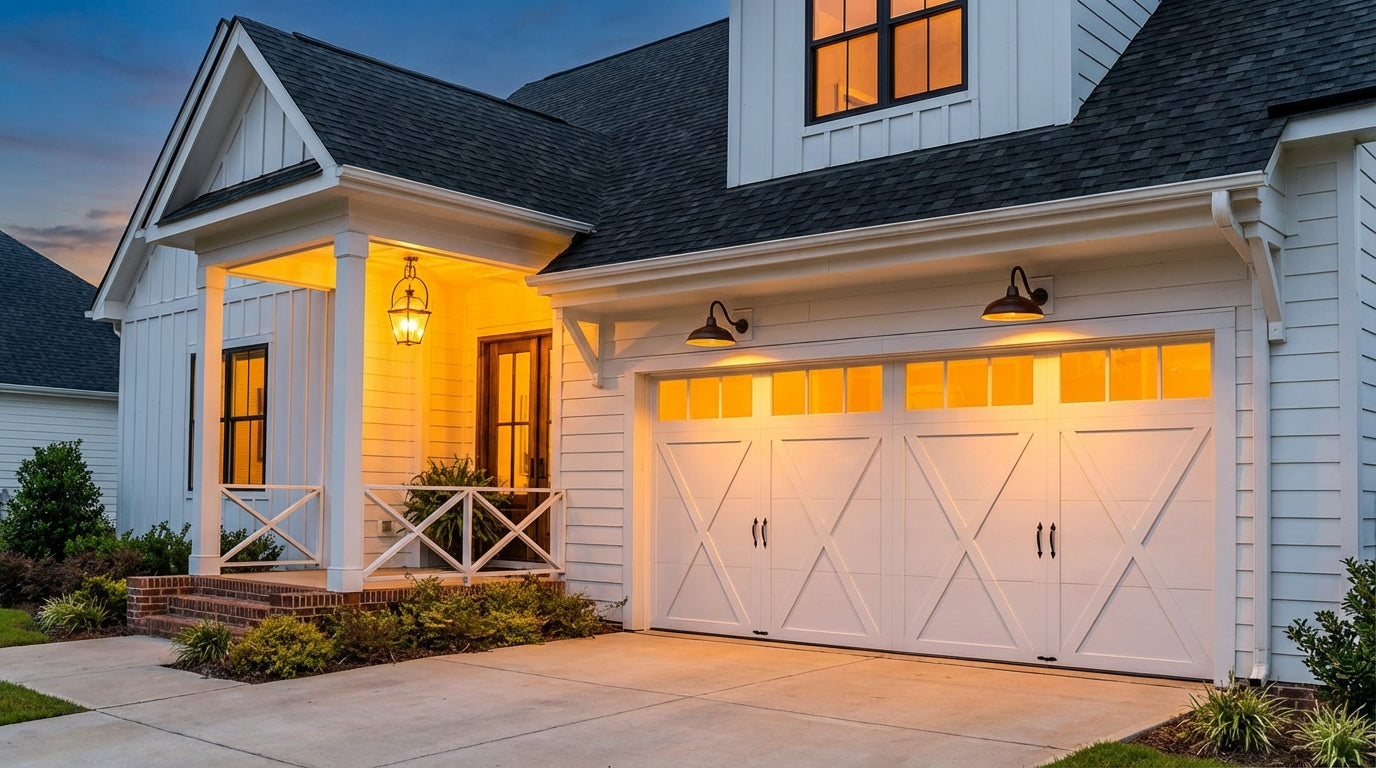
- The Gooseneck Solution: Utilizing gooseneck arms here breaks up the vertical expanse of siding above the header.
- Security Integration: This zone requires higher lumen output for safety. A fixture like the LED Barn Light with Photocell is often specified here. Its Dusk-to-Dawn functionality ensures the service perimeter is secure without manual switching, satisfying both the aesthetic of the barn vernacular and the utility of a commercial floodlight.

3. Transitional Spaces
Avoid the "runway effect" of lining a path with too many soldier-like stakes. Instead, use architectural step lights recessed into masonry or low-profile path lights that disappear into the landscaping.
Placement Logic Table
| Zone | Primary Function | Recommended Fixture Type | Mounting Height (AFF) |
|---|---|---|---|
| Main Entry | Focal / Task | Wall Sconce or Hanging Pendant | 66" - 72" (Center of J-Box) |
| Garage | Security / Ambient | Gooseneck RLM | 12" - 18" Above Door Header |
| Service Door | Utility | Compact Bulkhead or Jelly Jar | 72" - 80" |
| Pathways | Safety / Guide | Low-Voltage Path Light | 18" - 24" (Fixture Height) |
IV. Technical Specification: Photometrics and Compliance
A fixture can look perfect in the box but fail on the wall if the photometrics are ignored.
📺 Related Video: 3000K vs 4000K outdoor lighting comparison
The Kelvin Temperature Debate: 3000K vs. 4000K
Lighting temperature defines the "feeling" of the home.
- Residential Warmth (2700K - 3000K): Best for entryways and patios. It mimics the warmth of incandescent bulbs and welcomes guests.
-
Functional Clarity (4000K): Often deemed "too cool" for a living room, 4000K is the standard for exterior security and expansive service areas (barns, detached garages, driveways). It provides a crisp, neutral white that renders movement and objects clearly.
- Specifier Note: Do not fear mixing temperatures if the zones are distinct. A 4000K security light on a detached barn does not conflict with a 3000K lantern on the front porch.
Dark Sky Compliance
As light pollution regulations tighten in 2026, Dark Sky compliance is no longer optional in many municipalities.
Pro-Tip: Defining Dark Sky Compliance
To be compliant, a fixture must be Full Cutoff—meaning it emits zero light above the horizontal plane (90 degrees). This reduces sky glow and minimizes light trespass into neighboring windows.Look for fixtures with deep shades or acrylic prismatic refractors that direct lumens strictly downward.
IP Ratings (Ingress Protection)
For exterior farmhouse applications, specifying the correct IP rating protects the client's investment.
- IP44: Sufficient for covered porches (damp rated).
- IP65: Mandatory for exposed goosenecks and barn lights (wet rated). It guarantees protection against direct water jets and dust ingress.
V. The "Golden Ratio" of Lighting: Sizing and Scale
The most common error in exterior lighting is undersizing the fixture. A "builder-grade" light often looks like a postage stamp on a large wall. To achieve a custom look, you must adhere to the Scale & Proportion Protocol.

The 1/3 and 1/4 Rule
Architects use this formula to ensure fixtures carry the appropriate visual weight:
-
Front Door Sizing:
- Measure the height of the door frame (including transom/trim).
- The total height of the light fixture should be 1/4 to 1/3 the height of the door.
- Example: For an 8-foot (96") entry system, the sconce should be 24" to 32" tall.
-
Garage Door Sizing:
- Measure the height of the garage opening.
- The fixture should be 1/4 to 1/3 the height of the opening.
- Double Garage: If using a single light between two doors, scale up to 1/3 the height. If using three lights (left, center, right), you can scale down to 1/4.
Visual Weight & The "Oversized" Trend
Modern Farmhouse design embraces "overscaling." A slightly larger fixture reads as intentional and luxurious. If a measurement falls between sizes, always size up. A robust 30W LED Barn Light with a substantial mounting arm commands the space, preventing the "floating light" syndrome on wide siding planks.
VI. Case Study Application: The Mixed-Use Farmstead
Consider a recent project: A custom new-build in a semi-rural setting.
- The Facade: White vertical board-and-batten siding with a charcoal metal roof.
- The Challenge: Lighting a long driveway and a detached workshop without ruining the rural night sky or clashing with the warm residential entry.
-
The Solution:
- Entry: Two large, matte black glass lanterns (3000K) flanking the mahogany door.
-
Workshop/Garage: Three Lumimuse LED Barn Lights installed on gooseneck arms above the bay doors.
- Why? The 4000K temperature provided clear task lighting for evening work. The photocell offered "set it and forget it" security, and the acrylic prismatic refractor ensured the 2370 lumens were cast broadly across the driveway, not up into the trees.
- Result: A cohesive narrative where the "residential" zone felt warm and the "working" zone felt secure, unified by the matte black finish.
VII. Conclusion
Modern Farmhouse exterior lighting is an exercise in restraint and precision. It requires looking beyond the style of the shade and analyzing the substance of the specification—scale, color temperature, and compliance.
By applying the 1/3 Rule and selecting fixtures that offer both architectural form and commercial-grade utility, you elevate the home from "trend-following" to "architecturally significant."
Ready to specify your elevation?
Ensure your lighting schedule balances aesthetic warmth with security-grade performance. Explore our architectural lighting collection to find fixtures that meet these rigorous standards.
Entity Comparison: Residential vs. Commercial Spec
| Feature | Standard Residential Fixture | Commercial-Grade Farmhouse Spec |
|---|---|---|
| Material | Thin Aluminum / Plastic | Die-Cast Aluminum / Galvanized Steel |
| Lumen Output | 600 - 800 Lumens | 2000+ Lumens (e.g., Lumimuse 30W Barn Light) |
| Control | Manual Switch | Integrated Photocell (Dusk-to-Dawn) |
| Optics | Exposed Bulb | Prismatic Refractor / Full Cutoff |
| Lifespan | 15,000 Hours | 50,000+ Hours |
What Architects Are Saying
"The ability to combine the classic RLM profile with high-output LED engines has changed how we light modern farmhouse exteriors. We no longer have to choose between the 'look' and the 'light'. Using a fixture with an integrated photocell on the garage elevation solves the security question without requiring a separate, ugly floodlight."
— Sarah Jenkins, AIA, Principal Architect