
Green building isn't just about energy efficiency anymore; it's about material transparency, documentation speed, and occupant wellness. For architects and green builders, the pain point is rarely finding a beautiful light—it's chasing manufacturers for Environmental Product Declarations (EPDs) and photometric data three days before a LEED submission deadline.
This guide decodes the technical LEED lighting requirements for v4.1 and ranks the top 10 brands that don't just sell fixtures, but actively simplify your path to certification.
What are LEED Lighting Requirements?
Entity Definition: LEED lighting requirements refer to the criteria set by the USGBC (U.S. Green Building Council) that lighting systems must meet to earn credits in the Energy and Atmosphere (EA) and Indoor Environmental Quality (EQ) categories. Key technical requirements include reducing Lighting Power Density (LPD) below ASHRAE 90.1-2022 baselines, minimizing light pollution via strict BUG Ratings, providing advanced controllability (dimming/occupancy), and disclosing material ingredients through Environmental Product Declarations (EPDs) and Declare Labels.
I. Decoding LEED Lighting Requirements (The Technical Criteria)
To specify correctly for a LEED v4.1 project, you must look beyond lumens per watt. You are building an Entity Graph of compliance where every fixture must satisfy multiple interconnected attributes.
📺 Related Video: LEED v4.1 lighting requirements explained
1. Energy & Atmosphere (EA): The LPD Baseline
The primary prerequisite is beating the Lighting Power Density (LPD) limits set by ASHRAE 90.1. In 2026, the baseline has tightened. If the standard allows 0.70 watts per square foot for an open office, your design needs to be significantly lower (e.g., 0.50 W/sqft) to earn points.
- The Specifier's Goal: Choose fixtures with high Luminaire Efficacy (140+ lm/W) to deliver required foot-candles with minimal wattage.
2. Indoor Environmental Quality (EQ): Light Quality & Control
This category focuses on the human experience.
- Glare Control: Fixtures must often achieve a UGR (Unified Glare Rating) of <19 to meet the "Glare Control" credit.
- Color Quality: CRI (Color Rendering Index) must be 90+ or meet specific TM-30 fidelity metrics.
- Controllability: 90% of individual occupant spaces must have individual lighting controls (dimming or multi-level switching).
3. Material & Resources (MR): The Transparency Revolution
This is where most manufacturers fail. To earn MR credits, you need:
- EPDs (Environmental Product Declarations): Third-party verified documents quantifying the lifecycle impact of the fixture.
- HPDs (Health Product Declarations): A chemical inventory ensuring no "Red List" ingredients are present.
LEED Credit Checklist for Lighting:
- EA Credit: Optimize Energy Performance (Requires LPD reduction).
- EQ Credit: Interior Lighting (Requires Glare Control + CRI 90+).
- EQ Credit: Daylight (Requires Daylight Harvesting sensors).
- MR Credit: Building Product Disclosure (Requires EPDs/Declare Labels).
- SS Credit: Light Pollution Reduction (Requires specific BUG ratings).
II. Top 10 Lighting Brands for LEED Projects (Categorized by Strength)
We have analyzed the market not just by price, but by "Specifiability"—how easily these brands provide the data you need for LEED documentation.
Category A: The Giants of Efficiency (Best for LPD Reduction)
These brands offer massive catalogs of DLC Premium listed products, ensuring you meet the strictest LPD budgets.
1. Acuity Brands (Lithonia / Peerless)
Acuity is a powerhouse for LEED projects. Their IBG High Bay series and Peerless architectural lines often come with readily available EPDs. Their integrated nLight control platform simplifies the "Controllability" credit by networking fixtures out of the box.
2. Cree Lighting
Known for pushing luminaire efficacy limits. Cree’s fixtures often exceed 150 lm/W, allowing designers to drastically reduce fixture counts while maintaining light levels. Their TRUE Zero Waste certification also supports MR credits for waste management.
3. Konlite (Commercial Value Leader)
For projects where budget pressures meet performance specs, Konlite is a strategic choice. Their Linear LED High Bay series balances high efficacy (reducing LPD) with standard 0-10V dimming, essential for EQ credits.

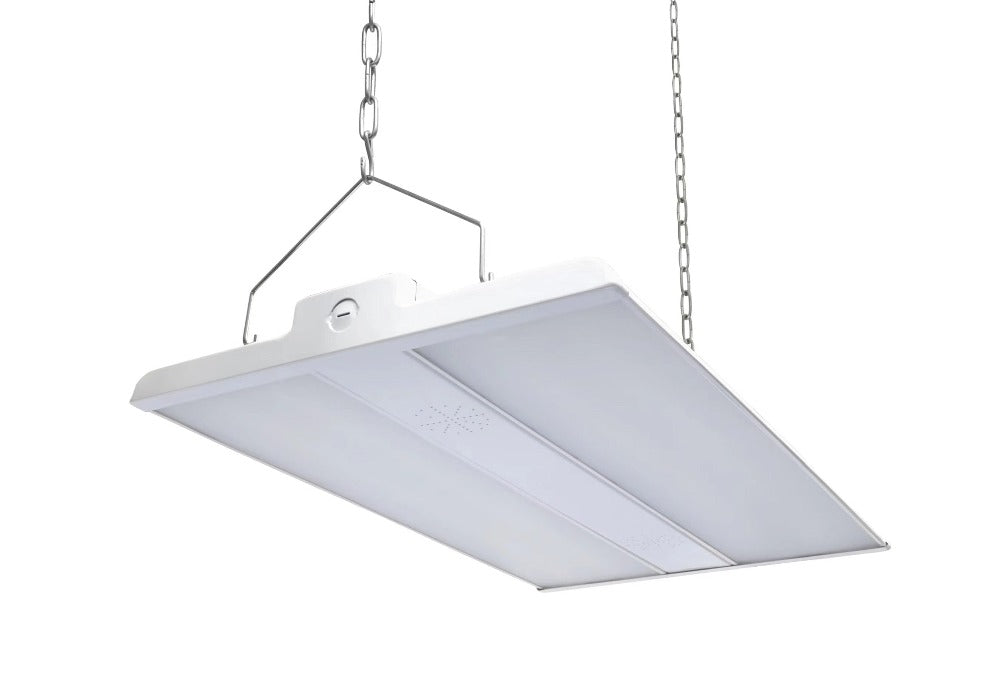
- Key Product: Linear LED High Bay Light - 225W. At 31,500 lumens, it replaces 600W HID fixtures, slashing energy use by 60%+ instantly.
Category B: The Leaders in Controls (Best for Advanced Metering & IQ)
LEED v4.1 heavily rewards "Advanced Energy Metering." These brands excel at IoT integration.

4. Signify (Philips Interact)
Signify’s Interact Pro system allows fixtures to report energy usage data directly to a BMS (Building Management System). This data stream is "gold" for earning LEED points in "Advanced Energy Metering."
5. Lutron
While primarily a controls company, Lutron's Vive wireless system pairs with almost any 0-10V fixture. Specifying Lutron guarantees you meet the "Individual Lighting Control" requirements without running miles of copper control wire.
Category C: The Transparency Champions (Best for EPDs/Materials)
If you are chasing the Building Product Disclosure and Optimization credit, start here.
6. Finelite
Finelite is arguably the leader in transparency. Over 90% of their portfolio carries Declare Labels (Red List Approved or Declared). If you need to prove material safety documentation quickly, Finelite is the safest bet.
7. Zumtobel
A European giant with a rigorous approach to sustainability. Their Cradle to Cradle certified products and detailed Environmental Product Declarations (EPDs) are the industry benchmark for accuracy.
Category D: Architectural & Wellness (Best for Glare & Human Centricity)
8. Focal Point Lights
Focal Point excels in two LEED areas: Acoustic Performance (with their acoustic baffle lighting) and material transparency (Declare labels). They are the go-to for open offices where both sound and light need controlling.
9. ERCO
ERCO focuses on "Greenology"—using precise optics to light only what is necessary. Their "Lighting Durability" promise (20-year service life) supports the Whole Building Life-Cycle Assessment credit by reducing replacement waste.
10. Eaton (Cooper Lighting Solutions)
With brands like Metalux and Crouse-Hinds, Eaton offers robust solutions for industrial LEED projects. Their documentation for Sustainable Sites (outdoor light pollution reduction) is excellent.
III. Entity Comparison: The 225W High Bay Benchmark
To illustrate how these brands compare in a real-world specification scenario, we analyzed the 225W Linear High Bay category. This fixture is the workhorse of industrial LEED projects (Warehouses, Gyms, Manufacturing).
| Brand | Product Model | Lumens | Efficacy (lm/W) | Controls | LEED Advantage | Price Est. |
|---|---|---|---|---|---|---|
| Konlite | Linear LED High Bay | 31,500 | 140 | 0-10V + Motion Sensor | High ROI / DLC Premium | $$ |
| Satco | 65-508 | 30,375 | 135 | 0-10V | Broad Availability | $$$ |
| Lithonia | IBG Series | ~30,000 | 138 | nLight Capable | Advanced Control Options | $$$$ |
| Hyperlite | Linear Series | ~30,500 | 135 | 1-10V | Budget Option | $ |
| AntLux | Linear 4FT | 26,500 | 120 | Non-Dimmable | Low Cost (Low LEED Value) | $ |
Analysis:
The Konlite 225W fixture hits a "sweet spot" for LEED specifiers. It offers 31,500 lumens (higher than Satco and Lithonia equivalents) at a lower price point, while still maintaining DLC Premium certification (crucial for rebates) and 0-10V dimming (mandatory for LEED EQ credits).
For a warehouse aiming for LEED Silver, specifying the Konlite fixture allows you to allocate budget savings toward other expensive credits (like solar or HVAC) without sacrificing lighting performance.
IV. The Hidden Hurdle: Documentation and Light Pollution
Navigating the "BUG" Rating
For Sustainable Sites (SS) credits, you must prevent light from trespassing beyond the property line. LEED requires fixtures to have specific B-U-G Ratings (Backlight, Uplight, Glare).
- Strategy: Do not just specify "Outdoor LED." Request the photometric IES file and check the "U" rating. It must be U0 (Zero Uplight) for most LEED projects to ensure Dark Sky compliance.
The Cost of Verification
A cheap fixture becomes expensive if it lacks data. If a manufacturer cannot provide a CRI report or an EPD within 24 hours, you risk delaying your LEED submission.
- Pro Tip: Brands like Finelite and Acuity have "LEED Submittal Packages" ready to download. For value-engineered items, ensure the supplier (like Lumimuse) can provide the DLC Qualified Product ID immediately, as this is often accepted as proof of efficiency.
V. Implementation Strategy for Green Builders

How to Spec LEED Lighting (Step-by-Step):
- Define the LPD Budget: Calculate your building's square footage and multiply by the ASHRAE 90.1-2022 baseline (e.g., 0.50 W/ft²). This is your "Wattage Wallet."
- Select High-Efficacy Fixtures: Use fixtures like the Linear LED High Bay to maximize lumens while spending the fewest watts from your wallet.
- Layer the Controls: Ensure every fixture has 0-10V dimming capability. Plan for Daylight Harvesting sensors in zones within 15 feet of windows (like those using LED Artificial Skylights or actual glazing).
- Request EPDs Early: Before issuing a Purchase Order, ask: "Do you have a Declare label or EPD for this specific model?"
- Check the CRI: For occupied spaces (Offices/Retail), verify the spec sheet lists CRI >80 (LEED Baseline) or CRI >90 (LEED Enhanced Credit).
VI. Conclusion
Meeting LEED lighting requirements is a balancing act between energy efficiency (EA) and material transparency (MR). While brands like Finelite and Lutron offer specialized documentation and controls, versatile fixtures like the Konlite Linear High Bay provide the raw performance and efficacy needed to meet aggressive LPD targets without breaking the project budget.
Key Takeaway: The best lighting brand for your LEED project isn't just the one with the nicest aesthetic—it's the one that provides the data you need to prove compliance to the USGBC.
Ready to spec your next Green Building project? Explore our range of LED Panel Lights and High Bays designed for modern energy codes.