Stop Burning Money: Vivosun AeroLight vs. HPS Energy Cost Analysis
Hydroponic farmers are facing a "Heat Wave"—not from the weather, but from their own equipment. As electricity rates climb in 2026, the cost of running a 1000W High-Pressure Sodium (HPS) system has shifted from a standard operating expense to a financial liability. The struggle to manage Vapor Pressure Deficit (VPD) while battling the radiant heat of HID bulbs is forcing growers to reconsider their infrastructure.
Quick Answer: LED Grow Light vs. HPS
In the battle of LED grow light vs. HPS, modern LEDs like the Vivosun AeroLight demonstrate superior energy efficiency. While HPS lights convert significant energy into waste heat, the AeroLight utilizes high-efficacy diodes to deliver a higher Photosynthetic Photon Efficacy (PPE) while consuming up to 40% less electricity. This results in lower monthly Operating Expense (OpEx) and reduced HVAC cooling requirements for hydroponic farmers.
This analysis compares the raw wattage, spectral quality, and the hidden "thermal tax" of traditional HPS systems against the Vivosun AeroLight to validate the Return on Investment (ROI) for your grow room.
II. The Efficiency Metric: PPE and Wall-Draw Wattage
Watts are what you pay for; Photosynthetic Photon Efficacy (PPE) is what your plants receive. This distinction is the core of the efficiency battle.
The Science of PPE
Traditional HPS bulbs, such as the Lumimuse HPS Indoor Grow Light Bulb, rely on igniting sodium gas. While effective for flowering, this technology hits a physics ceiling, rarely exceeding a PPE of 1.7–1.8 μmol/J. This means for every joule of electricity used, you get fewer than 2 photons of usable light.

In contrast, the Vivosun AeroLight leverages modern semiconductor technology to achieve a PPE of 2.75 μmol/J. It converts electricity into Photosynthetically Active Radiation (PAR) with far greater precision, minimizing waste.
Wattage vs. Output: The 40% Gap
To match the light intensity (PPFD) of a standard 1000W HPS fixture (which typically draws ~1150W from the wall including the ballast), you do not need 1000W of LED power. You only need approximately 650W of Vivosun AeroLight power. This 500W difference is not "lost" light—it is energy that HPS systems waste as heat.
Comparison: Vivosun AeroLight vs. 1000W HPS
| Feature | 1000W HPS System | Vivosun AeroLight (Equiv. Setup) |
|---|---|---|
| Input Power (Wall Draw) | ~1,150 Watts | ~650 Watts |
| PPE (μmol/J) | ~1.7 μmol/J | 2.75 μmol/J |
| Heat Output (BTU/h) | ~3,921 BTU/h | ~2,216 BTU/h |
| Spectrum Type | Narrow (Red/Yellow) | Tunable Full Spectrum |
| Cooling Requirement | High (Active HVAC required) | Passive + Integrated Fan |
III. The "Thermal Tax": Heat Dissipation and HVAC Costs
The cost of a light is not just the electricity it consumes—it is the cost to remove the heat it creates.
📺 Related Video: HPS vs LED grow light heat comparison test
The HPS Radiant Heat Problem
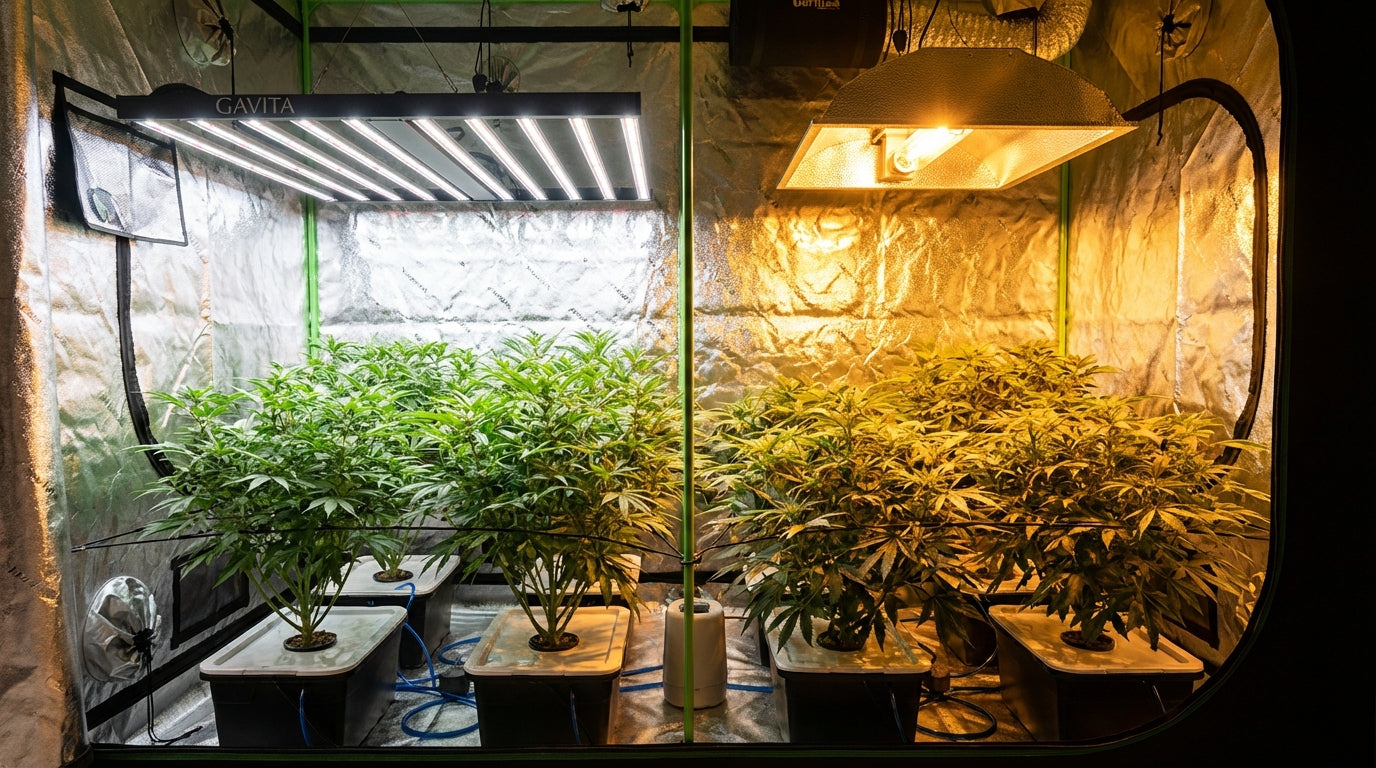
HPS bulbs operate by creating an arc stream that reaches extremely high temperatures. This generates massive amounts of Infrared (IR) radiation. This radiant heat travels directly to the plant canopy, raising leaf surface temperatures. To counter this, growers must run air conditioning units aggressively, increasing the facility's "Thermal Tax."
The AeroLight Cool Factor
LEDs produce heat, but they do not project it forward. The heat dissipates upward via heat sinks. This allows the Vivosun AeroLight to hang closer to the canopy without burning plants, preserving terpenes and trichomes that HPS heat can degrade.

Information Gain: The Integrated Circulation Advantage
Most LED comparisons focus solely on diodes. The Vivosun AeroLight introduces a unique entity to the equation: Integrated Circulation.
Standard LED setups require growers to purchase separate oscillation fans to prevent micro-climates. The AeroLight features a patented central fan built directly into the fixture.
- VPD Balance: By pushing air directly through the center of the light and down into the canopy, it equalizes humidity and temperature pockets.
- Reduced Gear: This eliminates the need for multiple clip-on fans, reducing the total wattage draw of the room further.
Data Estimate: For every 1000W of HPS lighting removed, you eliminate ~3,400 BTUs of heat load. This allows you to downsize your HVAC usage or capacity significantly.
IV. Spectral Quality: Full Spectrum vs. Sodium Glare
The HPS Limitation
The Lumimuse HPS bulb is a powerhouse for flowering due to its rich 2100K spectrum. However, this narrow red/orange focus has limits. It lacks the blue wavelengths necessary for tight internodal spacing during the vegetative stage, often causing plants to "stretch" or experience shade avoidance syndrome.
The Tunable Spectrum Advantage
The Vivosun AeroLight utilizes a Tunable Spectrum. Through the Vivosun GrowHub controller, growers can shift the spectral output:
- Seedling/Veg Mode: Higher Blue ratio for compact, strong roots.
- Flower Mode: Deep Red (660nm) and Far-Red (730nm) focus to stimulate biomass.
- UV Mode: Introduces UV wavelengths to potentially increase secondary metabolite production.
This versatility means one fixture covers the entire lifecycle, unlike HPS systems that often require swapping Metal Halide (MH) bulbs for vegetative growth.
V. ROI Calculator: When Does the LED Pay for Itself?
HPS systems are undeniably cheaper upfront. A 600W Lumimuse HPS bulb and fixture cost significantly less than a high-performance LED array. However, the "cheap" option becomes expensive quickly when running 12-18 hours a day.

The Break-Even Analysis
Consider a commercial hydroponic setup running 20 lights. Switching to Vivosun AeroLight technology impacts the bottom line in three distinct ways:
- Direct Electric Savings: Reducing wall draw from 1150W to 650W saves ~500W per hour. At $0.18/kWh, running 12 hours a day, this saves ~$394 per light, per year.
- HVAC Savings: Reducing the heat load by ~40% slashes AC runtime. Industry estimates suggest this adds another 20-30% in operational savings.
- Bulb Replacement Savings: HPS bulbs degrade. To maintain peak yields, bulbs like the Lumimuse 600W HPS should be replaced every 9-12 months. The Vivosun AeroLight is rated for 50,000+ hours (L70), eliminating replacement costs for over 5 years.
The Verdict: Most growers see a full ROI in 12 to 18 months, after which the savings become pure profit.
VI. Conclusion
The "Battle" between LED grow light vs. HPS is no longer about which technology grows plants—both do. The battle is about Operating Expense (OpEx) and environmental control.
While traditional options like the Lumimuse HPS Indoor Grow Light Bulb remain a viable choice for growers prioritizing low upfront costs or specific heating needs, the Vivosun AeroLight wins on efficiency. By integrating high-PPE diodes with a revolutionary circulation system, it reduces the holistic energy load of the grow room, turning electricity savings into higher yields.
Upgrade your hydroponic setup today. Switch to the Vivosun AeroLight to cut costs and optimize your grow environment, or browse our range of traditional lighting solutions.
What Growers Are Asking (FAQ)
Does the Vivosun AeroLight run hotter than HPS?
No. While the unit feels warm to the touch, the total BTU output is significantly lower than HPS. The integrated fan also actively cools the heat sink while circulating air to the canopy.
Can I use the AeroLight for the vegetative stage?
Yes. Unlike the 2100K spectrum of HPS bulbs which is optimized for flowering, the AeroLight features a tunable spectrum perfect for seedling, veg, and bloom phases. (See: How to Use LED Grow Lights).
How does the integrated fan help yields?
By improving airflow directly inside the canopy, the fan helps balance VPD, ensuring plants can transpire effectively. This reduces the risk of mold and strengthens plant stems.