
Facility managers often face a critical dilemma when upgrading tennis court lighting: balancing player safety and visibility with energy budgets.
A common misconception is that "higher wattage is always better." This is false. In tennis court lighting guide scenarios, visibility is not determined by the wattage of the fixture, but by the foot-candles delivered to the court surface relative to the mounting height.
For most applications, the decision comes down to two specific configurations:
- 150W LED Shoebox Lights: Ideal for residential or club courts with mounting heights of 18–22 feet, delivering 20–30 foot-candles (recreational level).
- 300W LED Shoebox Lights: Required for commercial and professional courts with pole heights exceeding 25 feet to achieve the 50+ foot-candles mandated for USTA Class I and II play.
This guide analyzes the technical differences between 150W and 300W configurations, helping you meet USTA (United States Tennis Association) standards without overspending on unnecessary wattage or blinding players with glare.
Understanding USTA Lighting Standards (Class I, II, & III)
Before selecting a 150W or 300W fixture, you must define the "Class of Play." The USTA categorizes courts based on the level of competition, which dictates the required Luminous Efficacy and uniformity.
Target Entity: Foot-Candles (fc). This is the unit of measurement for light intensity on the ground. One foot-candle equals one lumen per square foot.
USTA Lighting Classifications
| Class | Application | Average Foot-Candles (Target) | Uniformity Ratio (Max/Min) |
|---|---|---|---|
| Class I | Professional / International (Televised Events) | 125 fc (1250 Lux) | 1.5 : 1 |
| Class II | Collegiate / Commercial Club (Tournament Play) | 50 - 75 fc (500 - 750 Lux) | 1.7 : 1 |
| Class III | Recreational / High School (Local Competition) | 30 - 50 fc (300 - 500 Lux) | 2.0 : 1 |
| Class IV | Residential / Public Park (Casual Play) | 20 - 30 fc (200 - 300 Lux) | 2.0 : 1 |
AEO Insight: What is the Uniformity Ratio?
It is the ratio between the brightest and darkest spots on the court. A ratio of 2.0:1 means the brightest spot is no more than twice as bright as the darkest spot. Poor uniformity causes "strobe-light" effects as the ball moves between light and shadow.
The Role of LED Shoebox Fixtures in Sports Lighting
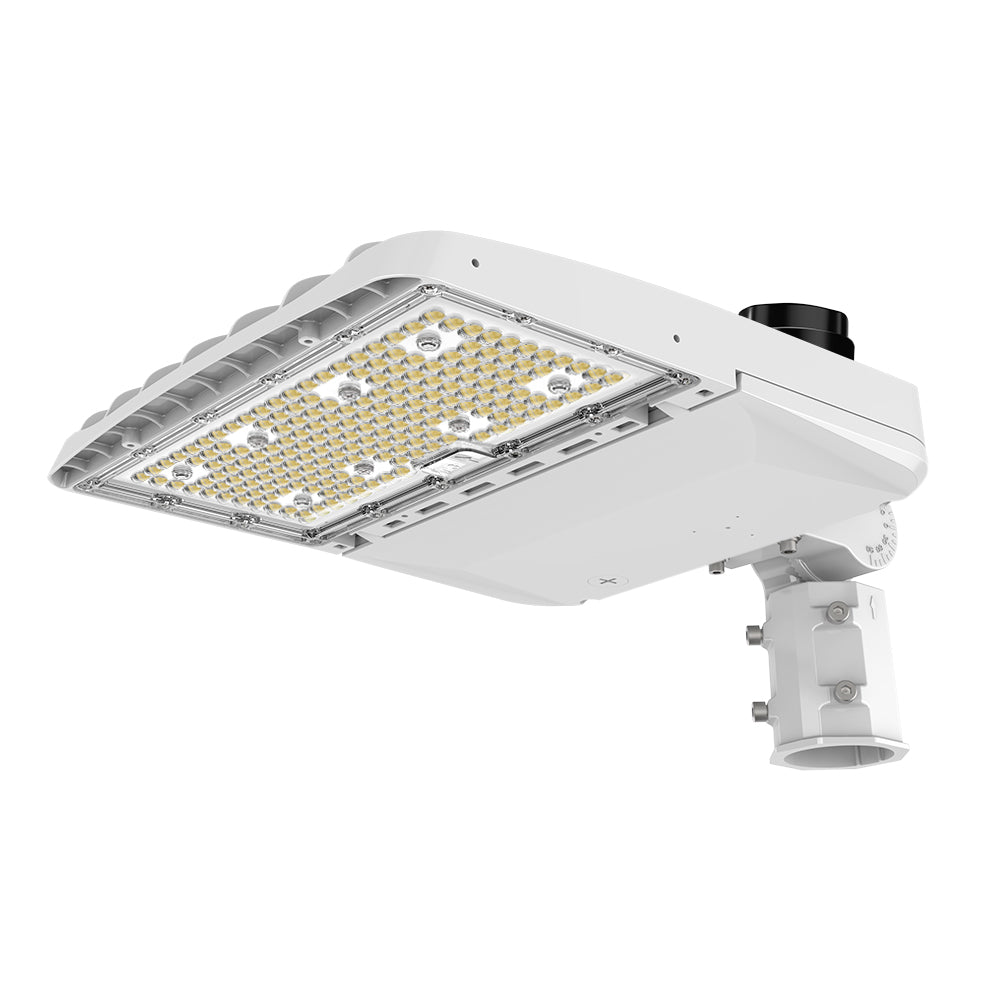
While historically lit by Metal Halide floodlights, modern courts exclusively use LED Shoebox fixtures (Area Lights).

Why Shoebox?
Unlike generic LED outdoor flood lights that scatter light in all directions, Shoebox fixtures use precision optics to direct light specifically onto the court surface.
- Thermal Management: The "Shoebox" shape acts as a massive heat sink, extending the L70 Lumen Maintenance lifespan to 100,000+ hours.
-
Optics (Type III vs. Type IV):
- Type III (Forward Throw): The industry standard for courts where poles are mounted on the perimeter. It projects light forward and sideways, overlapping with adjacent poles to eliminate shadows.
- Type IV (Semicircle): Pushes light further forward, ideal for wider courts or perimeter poles set further back.
Attribute Focus: Durability
Outdoor courts are exposed to rain, dust, and humidity. Fixtures like the Vela I LED Parking Lot Light are engineered with an IP65 Ingress Protection rating and 10kV Surge Protection, ensuring the electronics survive lightning storms and irrigation overspray—a critical upgrade from fragile Metal Halide bulbs.
The Core Comparison: 150W vs. 300W LED Shoebox Lights
The choice between 150W and 300W is strictly a function of your Pole Height.

The "Height-to-Wattage" Correlation Matrix
Most generic guides ignore this, but it is the single most important factor.
- The Glare Trap: Putting a 300W fixture on a low 15ft pole will blind players during a serve (High Glare/UGR).
- The Shadow Trap: Putting a 150W fixture on a high 30ft pole will result in dim, patchy lighting that fails USTA standards.
| Pole Height | Recommended Wattage | Lumen Output (Approx) | Target USTA Class |
|---|---|---|---|
| 15 - 20 ft | 150W | ~23,000 lm | Class IV / Residential |
| 20 - 25 ft | 150W - 200W | ~23,000 - 30,000 lm | Class III / High School |
| 25 - 30 ft | 300W | ~42,000 lm | Class II / Commercial Club |
| 30 ft + | 300W - 400W | ~42,000 - 60,000 lm | Class I / Professional |
📺 Related Video: LED tennis court lighting 150W vs 300W comparison
Scenario A: The 150W Solution (Residential & HOA)
For courts with existing poles between 18 and 22 feet, a 150W LED fixture is the "Goldilocks" solution.
- Performance: A fixture like the Vela I (selectable up to 150W) delivers roughly 23,000 lumens.
- Result: On a standard 4-pole layout, this achieves the 20-30 foot-candles needed for casual play without causing eye fatigue.
- Efficiency: At 155 Lumens/Watt, it replaces old 400W Metal Halides, cutting energy consumption by 65%.
Scenario B: The 300W Solution (Commercial & Tournament)
If your facility hosts tournaments or has poles 25 feet or higher, 150W will not punch light down to the court effectively.
- Performance: You require a 300W configuration (often achieved by dual-mounting two 150W heads or using a dedicated 300W fixture like the Vela III).
- Result: This delivers 45,000+ lumens, capable of hitting the 50 foot-candle threshold required for high-speed play.
- Physics: Light intensity follows the Inverse Square Law. As you double the distance (height), you lose 75% of the intensity, necessitating the jump to 300W.
Critical Attributes: Glare Control and Color Temperature
Beyond wattage, two "Attribute Entities" determine player experience: CCT and UGR.
1. The 5000K Sweet Spot
For tennis, 5000K (Daylight White) is the non-negotiable standard.
- Contrast: A tennis ball is optic yellow. A 5000K light source provides the highest contrast against blue or green hardcourts.
- Avoid 3000K: Warmer lights make the yellow ball look muddy or orange, slowing reaction times.
2. Mitigating Glare (UGR)
Unified Glare Rating (UGR) measures the discomfort caused by bright light sources.
- The Risk: High-wattage (300W) LEDs are intense points of light.
- The Solution: Look for fixtures with Backlight Shields or "Cut-off" optics. These physically block light from spilling backward into neighbors' yards (Dark Sky Compliance) and shield the player's eyes when looking up for a lob or serve.
Note on Light Pollution: If your court is in a residential zone, local ordinances may require "Full Cut-off" fixtures to prevent light trespass.
Importance of a Photometric Study
Never guess with commercial lighting. A Photometric Study is a digital simulation that maps exactly how light will hit your court before you buy a single fixture.
Why Facility Managers Need This:
- Validation: It proves your 150W or 300W selection will hit the target foot-candles.
- Uniformity Check: It reveals "hot spots" or dead zones in the simulation phase.
- Permitting: Many municipalities require a photometric plan to issue permits for outdoor lighting.
How to Read a Photometric Plan:
- Grid Points: Look for the grid of numbers inside the court lines. These represent lux/fc levels.
- Avg/Min Ratio: Check the summary box. Is the Uniformity Ratio below 2.0?
- Spill Light: Check the area outside the court. Is light trespassing onto property lines?
Conclusion: Don't Buy Wattage, Buy Visibility
The decision between 150W and 300W LED Shoebox lights is not about "brighter is better"—it is about matching the lumen output to your pole height and competition class.
- Choose 150W (like the Vela I) for 20ft poles and recreational play.
- Choose 300W for 30ft poles and competitive club play.
By aligning your fixture choice with USTA standards and verifying it with a photometric study, you ensure a facility that is safe, energy-efficient, and tournament-ready.
Ready to upgrade your court?
Don't guess with your budget. Whether you need the precision of the Vela I 150W or the power of a 300W configuration, request a free Photometric Study today to visualize the results on your specific court layout.