Is your flag fading into the shadows the moment the sun sets?
For many homeowners, the American flag is more than a piece of fabric; it’s a statement of pride. But when darkness falls, that statement often disappears—or worse, violates the U.S. Flag Code, which explicitly requires proper illumination for 24-hour displays.
The dilemma isn't whether to light it, but how. Do you trench through your manicured lawn to run Line Voltage wires, or do you trust a Photovoltaic (Solar) fixture to survive a dark, freezing December night?
This flagpole lighting guide moves beyond generic advice. We’ll break down the physics of lumen-to-height ratios, expose the "Latitude Reality" of solar power, and help you decide between the convenience of solar and the reliability of wired solutions.
1. The "Why": U.S. Flag Code & Lighting Etiquette
Before analyzing volts and watts, we must understand the "Entity" governing this entire project: U.S. Code Title 4, Chapter 1.
While no "Flag Police" will arrest you for a dark pole, the code establishes the respectful standard.
The Rule: "When a patriotic effect is desired, the flag may be displayed twenty-four hours a day if properly illuminated during the hours of darkness."
What defines "Properly Illuminated"?
It does not mean a faint glow that looks like a dying flashlight. In semantic search terms, proper illumination requires:
- Distinct Rendering: The red, white, and blue must be recognizable as distinct colors, not grayscale shadows.
- Angle of Incidence: The light must cover the flag at full extension (flying in the wind), not just when it is draped flat against the pole.
2. The Core Debate: Solar Flagpole Lights vs. Wired Solutions
This is the decision that paralyzes most buyers. It comes down to a battle between Installation Friction (Wired) and Performance Reliability (Solar).
📺 Related Video: Solar vs wired landscape lighting comparison
Option A: Solar Power (Photovoltaic)
The Weekend Warrior’s Choice.
Modern solar lights, like the Watchdog II Solar Security Light, utilize Lithium-Ion (Li-ion) batteries and high-efficiency panels. They eliminate the need for electricians and trenching.
- The "Pro" (Convenience): You can install a solar spotlight in 5 minutes. No cables, no digging, no impact on your electric bill.
- The "Con" (The Latitude Problem): Solar relies on sunlight. If you live in Seattle or Michigan, winter offers short days (low charge) and long nights (high drain). A generic solar light that works perfectly in Florida may fail by 2:00 AM in a Northern winter.
Option B: Wired Solutions (Low Voltage & Line Voltage)
The Permanent Fixture.
This involves running wire from your home’s transformer or breaker panel to the flagpole base.
- The "Pro" (Consistency): Your flag is lit with 100% intensity, 365 nights a year, regardless of cloud cover or snow.
- The "Con" (Labor): It requires trenching, potentially hiring an electrician, and buying a transformer.
Comparison Matrix: Solar vs. Wired
| Feature | Solar Spot / Disk | Wired (Low Voltage 12V) | Wired (Line Voltage 120V) |
|---|---|---|---|
| Install Difficulty | 1/10 (DIY Friendly) | 6/10 (Requires Burying Wire) | 9/10 (Pro Electrician Rec.) |
| Upfront Cost | Low ($40 - $150) | Medium ($200+) | High ($500+) |
| Operating Cost | $0 (Free Energy) | Low (LED Efficiency) | Low (LED Efficiency) |
| Lumen Output | 200 - 1,200 lm | 500 - 2,000+ lm | 2,000 - 10,000+ lm |
| Reliability | Weather Dependent | 100% Constant | 100% Constant |
| Best For | Retrofits & Sunbelts | New Landscapes | Commercial / 30ft+ Poles |
3. The "Lumen-to-Height" Ratio (The Secret Formula)
Most generic guides skip this, leaving you with a light that is too dim for your pole. To rank for Information Gain, we use the Inverse Square Law of light. As the light travels up the pole, its intensity drops drastically.

Use this "Golden Ratio" to select your fixture brightness:
-
15ft - 20ft Pole (Residential Standard):
- Minimum: 300 Lumens
- Ideal: 600 Lumens
-
25ft Pole (Estate / Commercial):
- Minimum: 800 Lumens
- Ideal: 1,000+ Lumens
-
30ft+ Pole:
- Requirement: Wired Spotlight (1,500+ Lumens) with narrow beam angle.
The Kelvin Temperature Factor:
Never ignore Color Temperature.
- 2700K (Warm White): Makes the white stripes look yellow and "muddy."
- 5000K - 6000K (Daylight): The standard for flags. It renders the white stripes crisp and the blue field deep and true. The Watchdog II, for instance, operates at 6500-7000k, ensuring the "High Noon" look even at midnight.
4. Mounting Styles: Topper vs. Ground Spot
The **Entity Graph** of flagpole lighting isn't just power; it's topology—where the light sits physically.
1. The "Topper" (Downlighting)
This is the "UFO" style disk that sits under the gold ball (finial) at the top of the pole.
- Analysis: While incredibly convenient, toppers often fail on poles taller than 20ft. Why? The Beam Spread is wide and diffuses before it hits the bottom of the flag. If the wind dies and the flag droops, the light is blocked by the fabric itself, leaving the stripes in darkness.
2. The Ground Spot (Uplighting)
This is the "Monumental" approach used by government buildings.
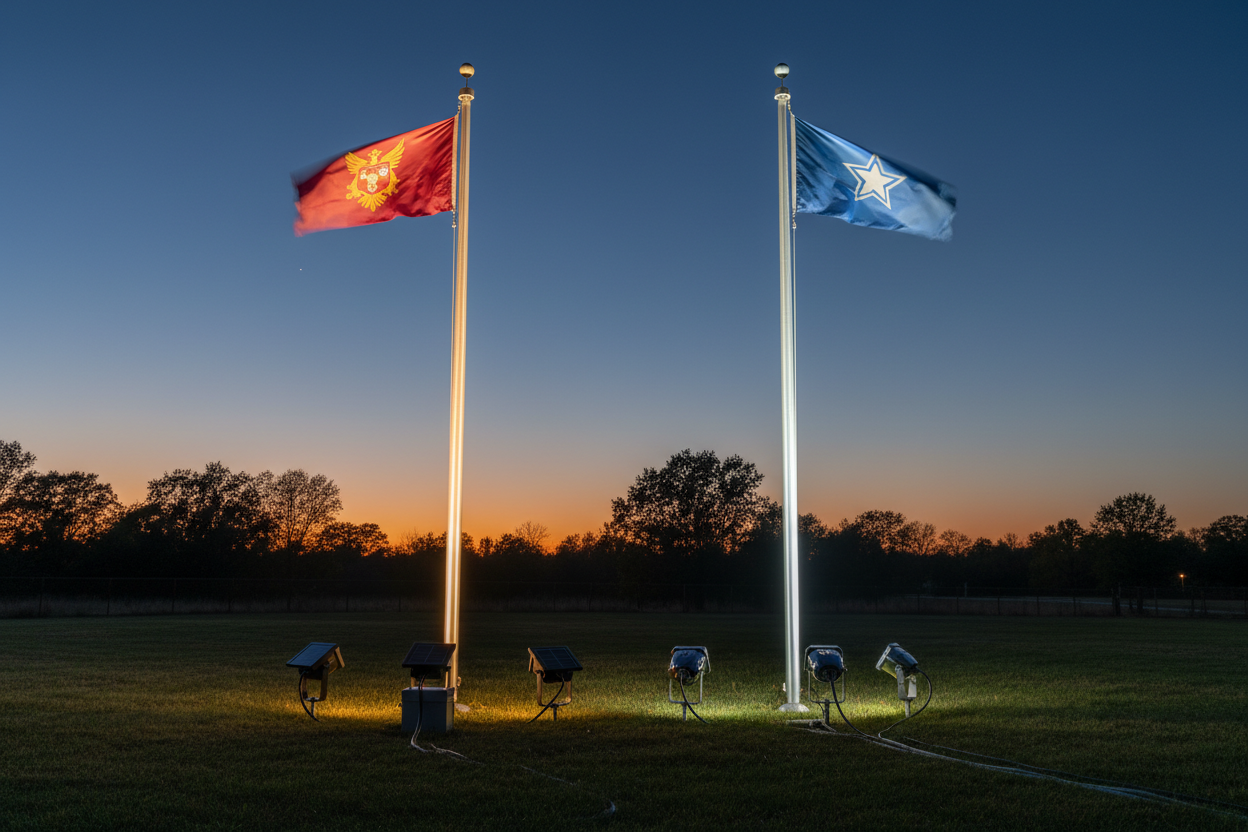
- Analysis: A spotlight placed at the base shoots light up.
- The Setup: For the best result, place the fixture 2-4 feet away from the base, angled up at 15 degrees towards the top.
- Pro Tip: High-performance units like the Watchdog II Solar Security Light are designed as "spots." With 1100 Lumens of output, a unit like this provides the "throw" necessary to reach the top of a 25ft pole, which weak disk lights cannot match.

Warning: If using a solar spotlight, be mindful of its mode. Some high-lumen units (1000+) are designed primarily as Motion Detectors for security. For a flagpole, ensure your light has a mode that allows for constant illumination, or use the motion sensor as a secondary security feature for the area around the flag (protecting against vandalism).
5. Buying Guide: Critical Specs to Check
When shopping, ignore marketing buzzwords like "Super Bright" and look for these Technical Entities:

-
Ingress Protection (IP Rating):
Outdoor lighting must handle rain, sprinklers, and dust.- Avoid: IP44 (Splash proof only).
- Buy: IP65 or IP67 (Jet water proof). The Watchdog II implies high durability suitable for "Professional Grade" security, aligning with these tougher standards.
-
Battery Capacity (mAh):
For solar, the battery is the gas tank.- The Math: A 200-lumen light needs roughly 2000mAh to last a winter night.
- The Watchdog Spec: It boasts a 4aH (4000mAh) Li-ion battery. This is double the capacity of cheap garden store lights, offering superior endurance for longer nights.
-
Solar Panel Type:
Look for Monocrystalline panels (black look) over Polycrystalline (blue look). They convert scattered sunlight (cloudy days) into energy more efficiently.
6. Conclusion: Which Light Respects the Flag Best?
The choice between solar and wired is a trade-off between physics and effort.
- Choose Wired If: You live in the profound North (Alaska, Northern tier US), have a pole over 30ft, or demand 100% flawless lighting for a commercial property.
- Choose Solar (Like the Watchdog II) If: You want a high-impact, 1100 Lumen solution without digging up your yard. It’s perfect for residential poles where ease of install and "Daylight" color temperature (6500k) are the priorities.
Ready to illuminate Old Glory?
Respect the colors by ensuring they never fade into the dark. Explore our collection of LED Solar Lights or check out the heavy-duty specifications of the Watchdog II Solar Security Light to see if high-lumen solar is the right fit for your property.