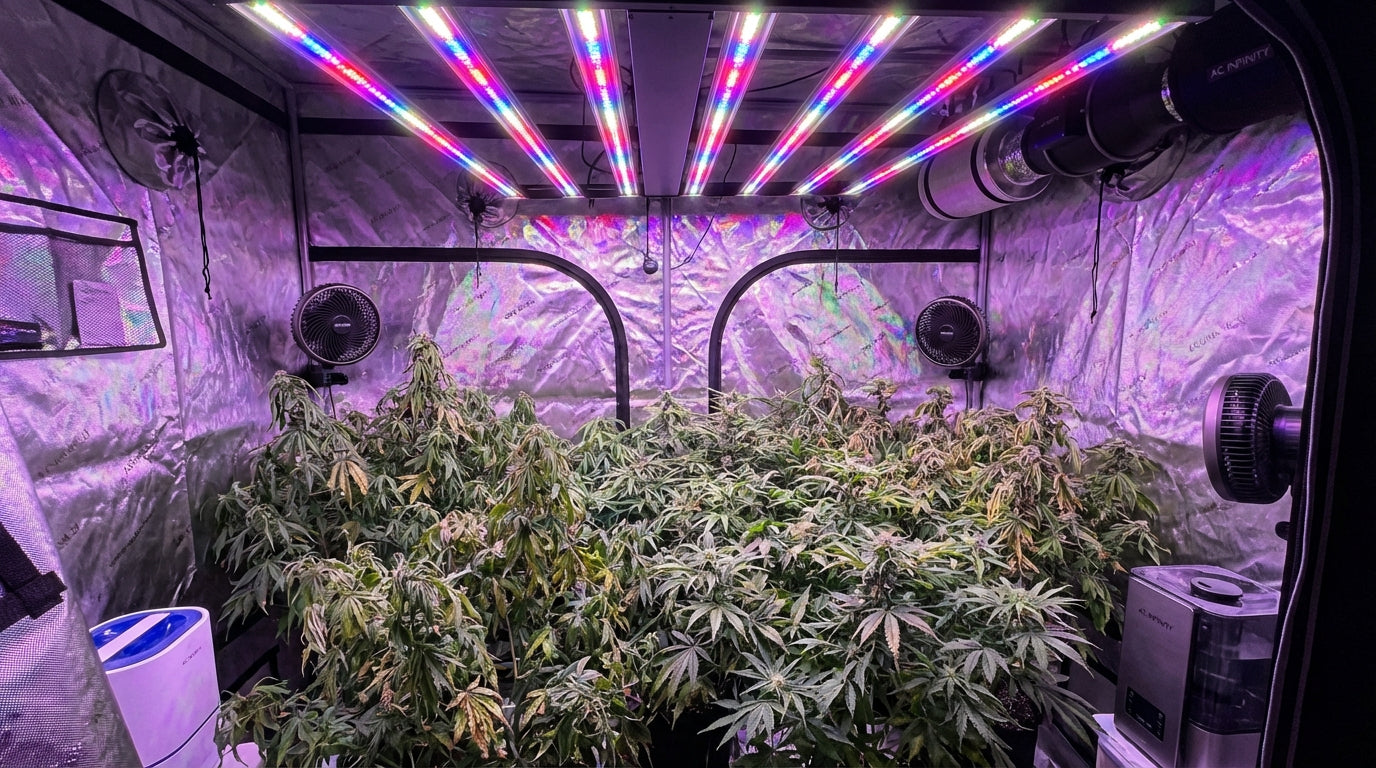
Is your grow room flashing like a disco? Stop immediately.
Flickering isn't just an annoyance for you; it is a critical environmental stressor for your plants. Intermittent lighting interrupts the photoperiod, confuses circadian rhythms, and significantly reduces the Daily Light Integral (DLI)—the total amount of photosynthetically active radiation (PAR) your canopy receives. In the worst-case scenario, this "light stress" triggers hermaphroditism in flowering plants, ruining your entire harvest with seeds.
This is not a generic "check your plug" guide. We are diagnosing the electrical entity failures—from driver degradation to PWM dimmer incompatibility—that cause modern LED systems to malfunction. If you are looking for a permanent grow light flickering fix, follow these steps carefully.
I. Introduction
Why Is My Grow Light Flickering?
The Short Answer: LED grow light flickering is typically caused by incompatible dimmer switches, loose driver connections, or voltage fluctuations (dirty power) in your grid. To fix it, you must tighten all DC wiring, bypass the dimmer to isolate the driver, and ensure your total wattage does not exceed the circuit's amperage capacity.
If you ignore this, you risk permanent damage to the LED diodes and the constant current driver.
We will treat this like a triage operation. We start with the physical connections (the easiest fix), move to the control systems (dimmers/timers), and finally diagnose the hardware heart of the system (the driver).
II. Physical Connection and Circuit Integrity (The "Quick Wins")
Before tearing apart your rig, we must rule out simple mechanical failures. Grow rooms are hostile environments; high humidity and vibration from oscillating fans can loosen wire nuts and terminal blocks over time.
1. The "Loose Neutral" Phenomenon
A loose neutral wire in your circuit breaker or wall outlet is a common culprit. If the neutral connection is weak, the voltage "floats," causing the LED driver to struggle to maintain a steady current.
- Symptom: The light flickers randomly, not in a rhythmic pulse.
- Fix: Check the wall receptacle and the connection point where the power cord enters the driver.
2. Inspecting DC Output and AC Input
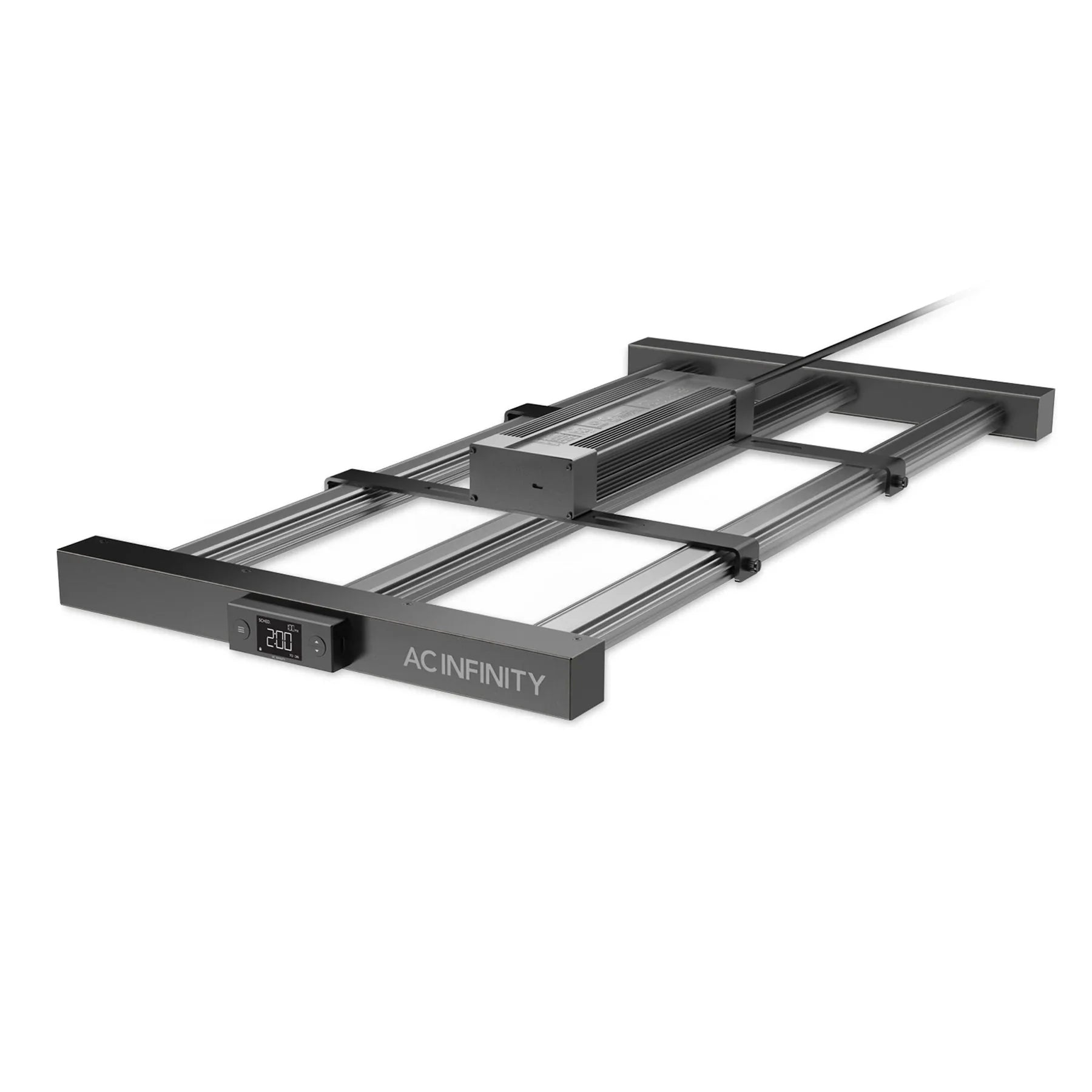
Most modern bar-style lights, like the AC Infinity IonFrame EVO3, use modular connections between the driver and the LED bars.

- AC Input: The cord from the wall to the driver.
- DC Output: The waterproof cable from the driver to the fixture.
- Action: Unplug the unit. Disconnect and firmly reconnect these locking cables. A single loose pin in a waterproof connector can cause arcing and flickering.
⚠️ SAFETY FIRST CHECKLIST
- Power Down: Always unplug the fixture from the wall, not just the timer.
- Capacitor Discharge: Wait 60 seconds after unplugging for the driver's capacitors to discharge residual voltage.
- Dry Hands: Never touch internal components with wet hands or in high humidity without rubber-soled shoes.
III. Analyzing Driver Compatibility and Load Stability
The LED Driver is the brain of your lighting entity. Its job is to convert high-voltage AC (Alternating Current) from your wall into low-voltage DC (Direct Current) for the diodes.
Thermal Throttling: The "Pulsing" Effect
High-performance drivers have internal safety mechanisms. If a driver overheats, it enters Thermal Throttling mode. It cuts power to cool down, then restarts, then cuts power again.
- The Result: A slow, rhythmic on-off pulse (usually every few seconds).
- The Solution: This is a ventilation issue. Move the driver outside the tent. Note: The IonFrame EVO3 is explicitly designed with a removable driver to mitigate this, allowing you to mount the heat source up to 6 feet away from the fixture.
Symptom vs. Cause Matrix
Use this table to identify your specific failure mode and find your grow light flickering fix.
| Symptom | Likely Entity Fault | Recommended Solution |
|---|---|---|
| Random, chaotic flickering | Loose wiring or "Dirty Power" (Grid fluctuation) | Check connections; install a Power Conditioner. |
| Rhythmic pulsing (1-3 sec intervals) | Thermal Overload (Overheating) | Detach driver; improve airflow over heatsink. |
| Strobing at low brightness only | PWM Dimmer Incompatibility | Bypass dimmer; replace with 0-10V analog dimmer. |
| High-pitched whine + Flicker | Electrolytic Capacitor Failure | Driver replacement required immediately. |
📺 Related Video: how to fix flickering led grow light driver
IV. The Dimmer Switch: PWM vs. Analog Conflicts
If your light works fine at 100% power but flickers when you dim it, the fault lies in the potentiometer (pot) or the dimming signal.

Pulse Width Modulation (PWM) vs. Constant Current
Many budget dimmers use PWM, which rapidly turns the light on and off to create the illusion of dimness.
- The Conflict: If the PWM frequency is too low, or if the driver expects an Analog 0-10V signal, the two systems fight. The driver tries to stabilize the current while the dimmer chops it.
- The Outcome: Visible strobing or a "shimmering" effect that stresses plant photoreceptors.
How to Bypass the Dimmer
To confirm this diagnosis:
- Locate the dimmer knob or controller port (e.g., RJ11/RJ14 jacks).
- Disconnect the controller or turn the dimmer to the "bypassed" or "100%" position.
- Result: If the flickering stops, your fixture is healthy, but you need a compatible controller. Smart controllers like the UIS Controller 69 PRO use advanced digital protocols to prevent this specific signal conflict.
V. Ghosting: When Lights Flicker While "Off"
Have you ever looked at your grow room during the dark cycle and seen a faint glow or intermittent flash? This is Ghosting.
The Mechanics of Residual Voltage
This occurs when small amounts of electricity leak through the neutral wire. It often happens when using cheap Single-Pole Mechanical Timers.
- The Flaw: A single-pole timer breaks the "Live" wire but leaves the "Neutral" connected. If your wall outlet has reversed polarity (common in older homes), the fixture remains energized even when "off."
- Impact on Photoperiod: Even 1-2 micromoles of light during the dark cycle can prevent cannabis plants from flowering or cause them to reveg.
The Fix: Double-Pole Timers
Switch to a digital Double-Pole Timer or a smart plug that physically disconnects both the Live and Neutral lines. This ensures zero voltage reaches the driver during the dark period.
VI. Advanced Troubleshooting: When to Replace the Driver
Sometimes, the hardware is simply dead. The most common failure point in any LED driver is the Electrolytic Capacitor.
Identifying Capacitor Failure
Capacitors store and regulate energy. Over time (usually 30,000–50,000 hours), the liquid electrolyte inside them evaporates.

- Visual Sign: If you can open the driver case (warning: voids warranty), look for cylindrical components with bulging tops.
- Auditory Sign: A failing capacitor often vibrates, creating a "hum" or high-pitched whine that syncs with the flicker.
The Economics of Repair
If your Mean Well or generic driver is dead:
- Under Warranty: Contact the manufacturer. Brands like Lumimuse offer 2-5 year warranties on the IonFrame series.
- Out of Warranty: You can buy a replacement driver (e.g., Mean Well HLG series) for $50–$100. However, matching the exact Voltage (V) and Amperage (A) is critical. If you are unsure, buying a new fixture is safer than risking a fire with mismatched voltage.
VII. FAQ: Common Grow Light Anomalies
- Q: Can power strips cause flickering?
- A: Yes. Cheap power strips often lack sufficient gauge wiring to handle the Inrush Current of multiple 280W+ fixtures starting simultaneously. Always use a heavy-duty, surge-protected power strip or plug directly into the wall.
- Q: Will flickering lights reduce my yield?
- A: Absolutely. Beyond the stress of photoperiod interruption, flickering represents a loss of efficiency. Your plants are receiving less total light energy (DLI) than your meter suggests because the light is technically "off" for milliseconds at a time.
- Q: My light flickers only when my AC turns on. Why?
- A: This is Voltage Drop. Your AC unit draws a massive current when its compressor kicks in, starving your lights of voltage. You need to move your grow equipment to a separate circuit breaker.
VIII. Conclusion
Ninety percent of LED grow light flickering issues are not catastrophic failures. They are usually loose wires, incompatible dimmers, or overheating drivers.
By systematically isolating the dimmer signal, checking for loose neutrals, and ensuring your driver has airflow, you can often save the fixture without spending a dime.
However, if your diagnostic reveals a failing driver capacitor or if your fixture is an older "blurple" model, it is time to upgrade. Modern fixtures like the AC Infinity IonFrame EVO3 eliminate these headaches with removable drivers, Samsung LM301H EVO diodes, and UIS smart integration that manages dimming digitally—ensuring your plants get pure, uninterrupted light.
Don't let a flickering light ruin your harvest. Check your connections today.
For more insights on optimizing your grow room environment, read our guides on How LED Grow Light Bulbs Overcome Indoor Plant Growth Issues and choosing the right LED Grow Lights for Indoor Plants.